Quick answer
Consider an automatic curler when you want a guided loading and motor-wrapping process and are willing to follow its exact orientation and release steps. Consider a wand when you prefer to place the wrap yourself and can follow that appliance's hand-protection method. Choose the sequence you can manage rather than assuming automatic means effortless or tangle-proof.
Compare the section path
This format comparison uses the Canadian English Conair Curl Secret CD1031C manual and US Conair CD705/CD706 wand guide as named examples. They illustrate different mechanisms, not a recommendation to import either electrical model or a claim that all tools in a category use identical steps.
Table: swipe sideways on a small screen, or focus and use arrow keys.
| Stage | Automatic heated-chamber example | Clipless wand example |
|---|---|---|
| Preparation | Check permitted hair state and controlled loading | Check permitted hair state and hand position |
| Placement | Guide the section into the model's loading path | Arrange the section on the working barrel by hand |
| Forming the wrap | Motor carries out the documented wrapping step | User positions and controls the wrap |
| Release | Follow the specified cue and withdrawal action | Follow the specified hand and release action |
| If hair catches | Use that model's stop/release instructions | Stop and follow the tool's release guidance |
Do not transfer a chamber's orientation, section limit or button sequence to a different automatic model. Likewise, a glove or cool-tip instruction belongs to the wand for which it is supplied, rather than being a shared method for every exposed barrel.
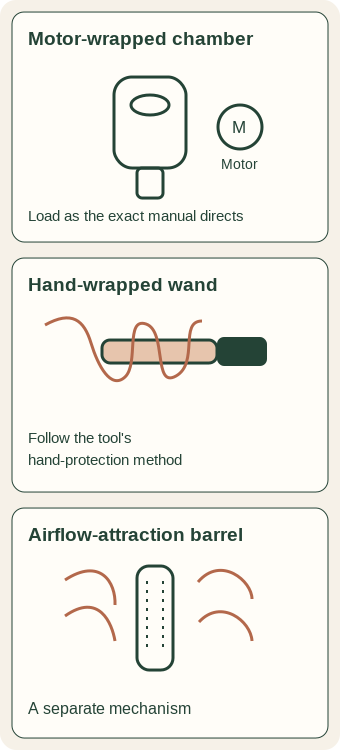
Automation changes the task you still perform
You still need to isolate a section, keep neighbouring hair clear and place the appliance as its manual directs. A motor takes over one part of the sequence; it does not choose the correct loading arrangement for you. Before buying, find the exact manual and check whether the diagrams make the loading and release understandable.
The CD1031C guide documents a release cue and a specific response if hair tangles. That response is not permission to keep drawing a caught section into the chamber. A marketed tangle-control feature does not guarantee that misuse or a caught strand is impossible.
Once the mechanism is chosen, follow automatic-curler use for the preparation and exact loading sequence. For a disconnected, cooled appliance, use automatic-curler care. Operating release and maintenance access are separate procedures, even when the same cover or chamber is visible.
If the tool attracts the ends around an airflow barrel, use airflow barrel versus curling wand. That comparison owns a different mechanism from the heated chamber here. Airflow-barrel use also keeps its entry path and completion cues separate from chamber loading.
A wand keeps wrap placement in your hands
The CD705/CD706 guide illustrates the hand-wrapped alternative. Read its protection and release directions; an uncovered barrel does not permit unrestricted contact with a hot surface.
For the separate choice between a clamp and a clipless tool, use curling iron versus wand. For actual wand operation, use the wand method with the exact appliance instructions. Neither owner is an automatic-curler loading tutorial.
Check access and length without inventing a cutoff
Consider where you need to place the appliance and how the section would enter and leave it. A short piece that cannot follow the documented path and a long piece that is difficult to isolate are different handling questions. Confirm the actual model's restrictions rather than assigning a universal minimum length to either format.
Rehearse only the manual's unpowered handling where appropriate. A cold rehearsal can clarify the movement, but it cannot demonstrate the motor's behaviour, a finished curl or a safe temperature for a particular person. Leave an undocumented fit or preparation question unresolved until the maker answers it.
Keep the finished shape separate from the mechanism
A barrel profile, selected programme and amount of separation can change the intended appearance. The word automatic does not establish longer-lasting curls, and a hand wrap does not guarantee a more natural result. After the permitted formation and cooling steps, brush-out choices cover a deliberate softer finish.
If the current tool already forms the shape and releases comfortably, a different mechanism is optional. If loading or hand placement is the repeated difficulty, compare that exact sequence before changing products, settings and the appliance together.