Quick answer
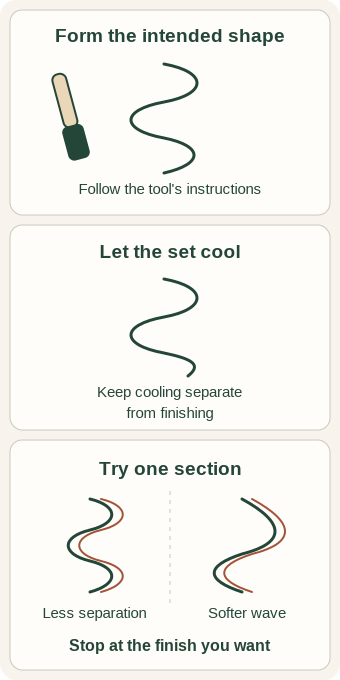
Let the styled curls cool before separating them. Start with one section, use the amount of finger, comb or brush contact the intended finish needs, then check the result before repeating across the head. Stop when you have the separation you wanted; softer waves are not automatically a failed curl set.
Name the finish before picking up a brush
You may want distinct curls with a little separation, broader connected waves or a more relaxed finish. Those goals do not need the same handling. Keep the original shape visible long enough to make that choice instead of brushing automatically because the curling step is complete.
If the shape already relaxes before you touch it, use why curls fall out for the formation and retention checks. A brush-out method cannot identify every reason the original set changed.
Separate formation, cooling and finishing
The Conair CD705/CD706 wand guide tells users not to comb or brush the formed curl until it cools. That is an instruction for the named wand family, not permission to copy its settings or hold time to another tool.
The ghd Australian straightener-curl tutorial also describes cooling before brushing a set into waves. These examples support keeping cooling and separation as distinct steps. They do not establish a fixed waiting time or guaranteed retention for every hair type.
Try one section first
- Complete the formation step using the chosen appliance's instructions, then set the appliance aside as its manual directs.
- Allow the formed set to cool before working through it. Do not use a clock alone as proof that every section is ready.
- Choose one visible section and consider whether gentle finger separation already gives enough change.
- If you want more blending, try a suitable comb or brush on that section without forcing through resistance. Keep the movement controlled and support the section where useful.
- Release it and check the resting shape before another pass. Compare it with an untouched section so the change remains visible.
- Repeat only the useful amount of separation elsewhere. Leave a section alone when it already matches the intended finish.
A comb and brush are options, not compulsory stages in a three-tool routine. For the general tool choice, use hairbrush versus comb. No tooth spacing or bristle type here guarantees a particular wave.
Distinguish a softer wave from an unwanted change
Table: swipe sideways on a small screen, or focus and use arrow keys.
| What happens | Question to ask | Useful response |
|---|---|---|
| Separate curls become a connected wave | Was that the intended finish? | Stop when the blending is sufficient |
| The first test opens more than wanted | Was less separation enough? | Leave other sections less disturbed |
| A tool catches | Is there a tangle or obstructed path? | Stop and free it rather than add force |
| The set drops before separation | Is finishing actually the unresolved stage? | Review the original formation and cooling routine |
One observation does not prove a cause. If you change the original barrel, product routine and brush-out at the same time, you will not know which change mattered. Keep a simple note for the next attempt instead of assuming repeated brushing will restore the original shape.
Add a finishing product only for a clear job
If a permitted hairspray or serum is part of the finish, follow its actual directions and review the appearance before another application. The brush-out does not require extra oil, an aerosol or another hot-tool pass. Hairspray use owns the application step and its separation from appliance use.
For curls formed with rollers, keep the roller's release instructions first. This page does not authorise pulling a roller out with a brush or combing a still-wrapped section.
A pressed wave pattern also has a separate formation and finishing sequence. Follow waver use and that tool's cooling instructions before deciding how much separation you want. This brush-out guide does not prescribe how the waver should be positioned or how long it should contact the hair.