For UK C6688U, the exact Style Secret Air manual distinguishes permitted cooled filter care from the permanently attached inlet mesh. Leave that mesh attached. A removable filter and the CD1031C care cover are different parts with their own cleaning permissions. The UK Wave/Style Secret comparison identifies the mode and model before care. Removal alone supplies no wash or active-tangle permission.
Quick answer
Switch off, unplug and let the appliance cool completely. Follow the exact manual for accessible surfaces and any removable care cover, then complete its drying and reassembly instructions before reuse. Do not force access to the motor body or turn an undocumented removal step into a cleaning method.
Separate maintenance from an active tangle
This page concerns cooled, disconnected maintenance. Hair caught during operation needs the model's stop and release procedure first. Do not open a care cover while a hot appliance is holding hair because a cleaning guide mentions a removable part.
Use automatic-curler operation for the loading boundary and exact-manual handoff. If the appliance is damaged or continues to behave abnormally, follow service guidance; do not assume the issue is ordinary residue.
Identify the cover before testing its movement
Read the model number and locate the maintenance section. Distinguish a part the maker permits you to remove from a seam, locking point or fixed housing. A demonstration for another generation does not authorise turning your appliance's cover.
The Canadian CD1031C instructions provide one specific example: after disconnection and cooling, they permit twisting off the cover, wiping the chamber and cover with a soft damp cloth, drying both and locking the cover back in place. Those permissions belong to that model.
Sort the parts before choosing an action
Table: swipe sideways on a small screen, or focus and use arrow keys.
| Area | Question to answer from the manual | Boundary |
|---|---|---|
| Exterior | Which cloth and moisture condition are permitted? | An exterior instruction does not authorise filling an opening |
| Cover | Is user removal documented for this exact part? | A seam or visible joint is not removal permission |
| Accessible chamber surface | What contact and drying method is specified? | Do not scrape or probe the mechanism |
| Motor body and controls | What user access is actually allowed? | External care does not authorise disassembly |
Do not turn a cloth instruction into soaking, rinsing or spraying. A wet cloth used on another product is not a shared permission for this appliance. Keep any maker-supplied cleaning tool attached to its specified purpose instead of substituting a sharp implement.
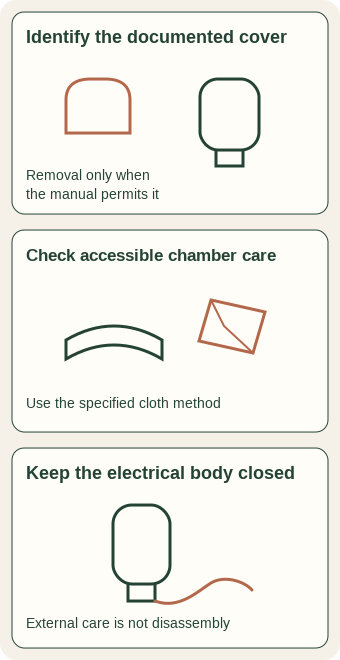
Work through one permitted care session
- Disconnect the appliance and confirm that all parts to be handled have cooled.
- Identify the exact surfaces and any removal step the maintenance section allows.
- Remove accessible loose material only using the documented method, keeping the openings and mechanism in view.
- Apply the permitted cloth method to the assigned surfaces. Do not escalate to scraping when residue remains.
- Complete the stated drying and reassembly steps. Check that any authorised removable part seats normally.
- Inspect the exterior, cord and accessible contact areas before storing or using the tool again.
If a part resists its documented action, stop and recheck the instructions. Forcing the joint can turn a maintenance question into a damaged fastening. If the manual does not establish the next cleaning step, ask the maker rather than adding a solvent or opening the housing.
Read what remains after cleaning
A visible deposit and a chipped, distorted or rough component are different findings. Cleaning does not restore a broken surface or prove that a motor fault is resolved. Keep a short note of the model, the permitted action completed and what remains so the support question is specific.
For a conventional exposed barrel, use curling-iron and wand care. That owner remains separate because it does not supply the access instructions for a motor-wrapped chamber.