Choose a clamp iron if you prefer a built-in clamp; choose a wand if you prefer a clipless wrapping format. Neither choice guarantees curl shape or longevity.
What to compare
Check barrel diameter, cool-tip and glove inclusion only when the exact model documents them. A tapered tool offers changing diameters; a fixed barrel gives one specified diameter.
Use the Curling Tool Finder to choose a format.
Follow the section from the end to release
With a clamp iron, place the section end where the exact instructions direct, close the clamp and turn the tool while controlling tension. Release the clamp before unwinding. That held end is useful if you prefer mechanical control, but poor placement can leave a line. With a clipless wand, hold the section and wrap it around the barrel by hand as directed, keeping the end controlled and following any glove or cool-tip instruction. Release without dragging the wrap across the hot surface.
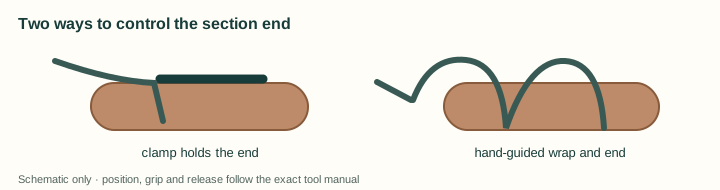
Clamp path: end → clamp → turn barrel → open clamp → release. Wand path: section → hand-guided wrap → controlled end → release. Neither path predicts curl duration.
Table: swipe sideways on a small screen, or focus and use arrow keys.
| Preference | Likely format | Watch point |
|---|---|---|
| Tool holds the end | Clamp, such as ghd Curve Classic Curl | End alignment and lever release. |
| Hand controls the wrap | Clipless, such as ghd Creative Curl | Hand position and maker protection directions. |
| Variable diameter along one barrel | Tapered wand | Where the section sits changes the geometry. |
If the desired difference is bend scale, read barrel size. If a clamp line appears, the crease guide covers placement and release. A tool you already control may be more useful than buying the other mechanism for an unproven performance claim.
Match the movement to the section
For an ordinary section, trace where the free end goes before turning on the tool. A clamp offers an anchor, but a short end can be bent by poor placement. A wand leaves the end outside a clamp and asks the user to hold it, with the protective position specified by the maker. On a taper, the section also changes its contact diameter as it travels. Practice the movement cold with the unplugged tool if needed; never use a guessed hand position on a hot wand.
The release step matters as much as the wrap. Open a clamp before moving a coil clear; for a wand, unwind or slide as the manual describes while avoiding snagging. If you frequently want one broad bend rather than a full wrap, another tool you already own may suit the task. Do not choose a wand because of a claimed universally more natural result or a clamp because of a claimed longer hold; neither follows from the mechanism alone.
Make the final choice
If the only problem with your clamp iron is a visible line, first change end placement and opening technique using its manual. If you dislike managing the lever even with correct placement, a clipless wand offers a different action, provided its hand-protection directions suit you. Do not move to a taper expecting it to solve a release problem; taper changes contact diameter, not the need for a controlled release.