Barrel size changes the scale of the possible bend or curl, but it does not guarantee the final shape or duration.
For the specific shape decision between two clipless wand profiles, compare tapered and cylindrical wands. This guide remains the owner of diameter and usable-length definitions.
Common US barrel sizes
First check whether enough length can wrap around the barrel without forcing the tool near the face or ears. Then decide whether the target is a compact curl or a broad bend. A 1-inch barrel is a middle starting point, not a guaranteed curl size: section width, clamp or wand format, technique and the exact tool's instructions all affect the shape. If short layers cannot wrap comfortably, choose a smaller barrel or another styling method rather than increasing heat to compensate. The hot-air brush comparison helps when the real goal is a blowout instead of a curl.
- 3/8 to 1/2 inch (10 to 13 mm): compact sections and tighter-scale styling.
- 3/4 inch (19 mm): a smaller standard option.
- 1 inch (25 mm): a common middle ground.
- 1 1/4 inch (32 mm): a larger standard option.
- 1 1/2 inches and larger (38 mm+): broad bends or waves.
- Tapered and interchangeable formats: vary along or between barrels.
Use the Curling Tool Finder to decide between clamp, wand and size bands.
Diameter, usable length and taper answer different questions
Diameter is the distance across a cylindrical barrel; it suggests the scale of the possible bend. Usable length is the heated span that can actually hold wraps without using the tip or handle. A tapered barrel changes diameter from one end to the other, so a single size cannot describe every contact point. Ask which number the manufacturer publishes before comparing tools.
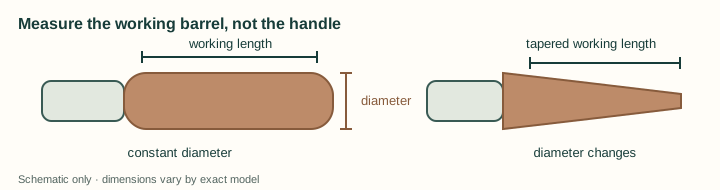
Cylinder: one labelled diameter across its width; working length runs along its heated side. Taper: narrower end → wider end; the section's placement changes the diameter it meets.
Table: swipe sideways on a small screen, or focus and use arrow keys.
| Exact example | Published US diameter label | Handling implication |
|---|---|---|
| ghd Curve Thin Wand | 0.55 inch, about 14 mm conversion | Compact cylinder, clipless wrapping. |
| ghd Curve Classic Curl | 1 inch, 25.4 mm conversion | Middle-size cylinder with clamp. |
| ghd Curve Soft Curl | 1.25 inches, about 32 mm conversion | Broader cylinder with clamp; check section reach. |
| ghd Creative Curl | Tapered design | Compare endpoint labels and placement, not one assumed diameter. |
Conversions above are mathematical conversions of the US labels, not separate product measurements. If a short section cannot make a manageable wrap, try a different section or cylinder. If a long section piles up on itself, divide it or seek a documented longer working surface. For the tool action, see clamp versus wand; for a curl that later opens, see retention troubleshooting.
Work through two sections before choosing
Try the shortest section and the longest section you intend to curl with an unheated cylinder or a paper approximation. Can each section form a manageable wrap and leave enough end to control? Does the long section crowd the usable barrel? This physical check is more informative than assigning a diameter by hair type. The actual heated tool must still be used only according to its instructions. A broad cylinder may create a gentler starting bend; it cannot guarantee a finished wave or how long that shape remains after brushing.
For a taper, ask for endpoint dimensions and where the section will sit. Calling it a 1-inch wand hides the variation along its length. For interchangeable sets, inspect which exact barrel is included in the package and whether it is supported by the handle generation. A displayed barrel range may describe a family, not the box you are buying. Keep a cylinder you already know how to use if a new number does not solve a reach or handling problem.