Short sections often make a compact barrel or narrow tool easier to guide, but there is no universal best size. Avoid a large-only format when you want close-section precision.
The ghd Curve Thin Wand has a published 0.5-inch cylindrical barrel. The Creative Curl Wand is tapered; a single 0.9-inch shorthand does not define both ends of that working profile. Compare sources in Product Explorer or use the finder.
Can the section reach around the working barrel?
For short sections, the first decision is physical reach. Take an unheated tool or a paper cylinder of roughly the advertised size and see whether a typical section can travel around it without pulling at the root. The point is to understand access, not to derive a universal minimum hair length. A large barrel can leave too little section to control, especially around a fringe or shorter layers.
The US ghd Curve Thin Wand is labelled 0.5 inch and the Classic Curl clamp is labelled 1 inch. The Soft Curl 1.25-inch clamp may suit a different section and bend preference, but its larger cylinder asks for more reach. A clamp holds an end once positioned; a wand asks for hand control and the maker's protective method. A narrow barrel is not automatically preferable if its working length or handle blocks comfortable positioning.
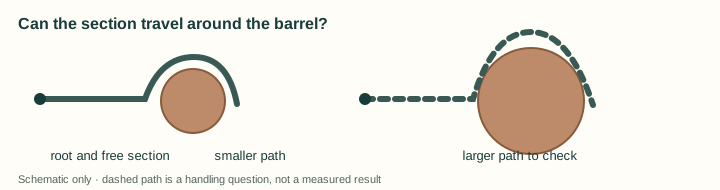
Section path: root → free length → around the chosen cylinder → controllable end. If the end cannot be held or released as the instructions require, try a smaller section, another format or your existing tool.
Table: swipe sideways on a small screen, or focus and use arrow keys.
| Section | Inspect | Reason |
|---|---|---|
| Short edge or fringe | Small cylinder and accessible tip | Room for a controlled wrap and release. |
| Longer top layer | 1-inch clamp or wand | May reach without needing the narrowest tool. |
| Mixed layers | Where handle and cool tip sit | Body access can matter more than headline diameter. |
See the diameter guide for labelled sizes and the format guide for release steps.
The tool body can block access
Two products with the same barrel diameter can differ in cool tip, clamp length, handle angle and usable heated span. A short section near the ear may reach a cylinder but still be awkward if the handle must be held at an uncomfortable angle. Check the actual tool geometry on a manufacturer image or dimensions when published, then test the motion with an unheated tool if you have one. Do not take a marketing photo as proof of an exact minimum hair length.
A clamp can hold a short end after careful placement; a wand leaves the end hand-guided. Choose the path that lets you maintain space from the hot surface and release the section without pulling. For layers that cannot make a controlled wrap around a chosen barrel, use another sectioning method or a non-curling approach rather than forcing a length rule. The material and heat-control labels are separate purchase questions from whether the section physically reaches.
Check the hardest section before comparing models
Use the shortest side or nape layer as a fit check. With the tool cool and unplugged, place the section where you expect to start. Check whether it reaches the working barrel, whether your hand stays clear of the hot surface, and whether you can release it without crossing the barrel. If one check fails, compare a different format or leave that layer out of the curl routine.
A 0.5-inch cylindrical barrel such as the US ghd Curve Thin Wand is a documented diameter example, while the tapered Creative Curl has more than one working diameter. Neither published size establishes the minimum hair length it can style; exact dimensions and the section path still decide access.
Make the final choice
At a short side layer, a cool tip and handle may take more room than the barrel itself. Compare the exact working geometry and whether the end can be released without crossing the hot surface. A product photo rarely shows the angle you will need at your own roots. Try the motion cold before deciding that a labelled small diameter solves access.