Work on hair in the state permitted by the exact iron, park unused hair, and keep the section end visible before closing the clamp. This guide uses the current US ghd Chronos Curve Classic 1-inch clamp iron as an attributed example; it does not make its movement universal.
Prepare the tool and working area
- Read the exact manual for permitted hair state, protection and resting surface. Conventional ghd Curve tools are described for dry styling.
- Detangle, apply only products permitted by their own directions, and clip unworked hair away.
- Choose a section that can lie flat on the working barrel without overlapping into a crowded bundle.
- With the tool unplugged and cold, practise opening the lever, placing the end and releasing it if the mechanism is unfamiliar.
Place, turn and release
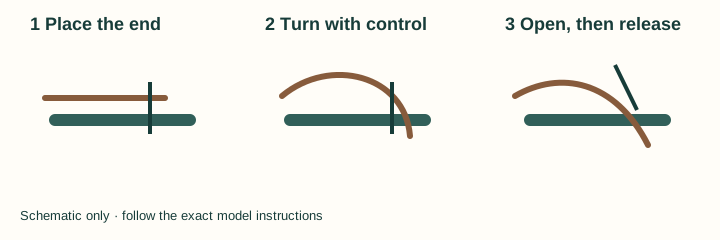
Hold the section where you can see its free end. Open the clamp, align the end as the exact instructions show, and close without folding a thick corner under the clamp edge. Use the maker-supported starting position and turn while maintaining an orderly wrap. “Away from the face” means the tool travels so the front section bends outward on that working side; it is clearer than a clockwise instruction that reverses in a mirror.
Do not invent a universal hold time or temperature. Follow the tool control and tutorial you are actually using. At release, open the lever first, then move the barrel clear without dragging a closed clamp along the section. Support the released curl only as the instructions permit, allow it to cool, and dress it after formation rather than repeatedly reheating it.
Read the sign before changing the routine
| Observed sign | Check | Useful change |
|---|---|---|
| End slips out | End was not visible or section was crowded | Reset a smaller manageable section; do not tighten pressure. |
| Hard clamp line | Folded end, paused closure or abrupt turn | Open, realign and keep the supported movement continuous. |
| Wrap crowds itself | Too much section for usable barrel length | Reduce section breadth; barrel diameter does not state usable length. |
| Release is difficult | Clamp is still closed or hair crosses the hinge | Stop, unplug if needed, let it cool and free it without pulling. |
Use the crease troubleshooting guide for a persistent line and the barrel-size guide for geometry. Compare clamp and wand handling only if the lever itself is the unmet need.
Exact example and evidence boundary
The current US ghd Chronos Curve Classic page identifies a 1-inch barrel and spring-activated lever. The ghd Curve safety guide supplies handling and heat-resistant-surface directions. Promotional finish and hold claims are not treated as independent performance evidence.
Keep the working side understandable
Name the side you are working on and decide whether the front section should travel toward or away from the face. Watch the free end rather than relying on a mirrored clockwise label. Keep the cord, clipped hair and resting surface outside that path. Complete one trial section and inspect its clamp line, wrap spacing and release before copying the motion elsewhere. This makes one handling variable visible at a time without promising a result.
If the section slides, open the clamp and reset it; do not close harder. If an end repeatedly folds, check whether the section is wider than the clamp or whether its placement conflicts with the exact tutorial. A tool that cannot accept the section cleanly may need a smaller section or a different permitted technique, not a hotter setting. Stop using a tool whose lever, coating, cord or stand is damaged and follow the maker's support route.