Quick answer
Consider a documented wet-to-dry system when combining those stages answers a practical need. Keep a conventional flat iron for its permitted dry-hair finishing task. Inspect the exact mechanism and modes: airflow styling need not mean plate-free construction, and a combined appliance can still contain a dry-only mode.
Start with the stage you intend to change
Write down your existing preparation, drying and finishing steps. Identify which one feels unnecessary or awkward. Removing a step from that list is a useful purchase aim only if the replacement's full method fits the work you actually do.
If most sessions are dry refreshes, a combined drying appliance may add a capability you rarely use. If the unresolved task begins after washing, compare its permitted starting state and drying sequence before judging its value. Keeping a separate dryer and iron remains a valid choice.
Compare mechanisms without merging them
The selected UK Airstrait listing describes airflow straightening without hot plates. UK Duet Style support describes hot air combined with heated plates. These are distinct constructions within a broader drying-and-styling task.
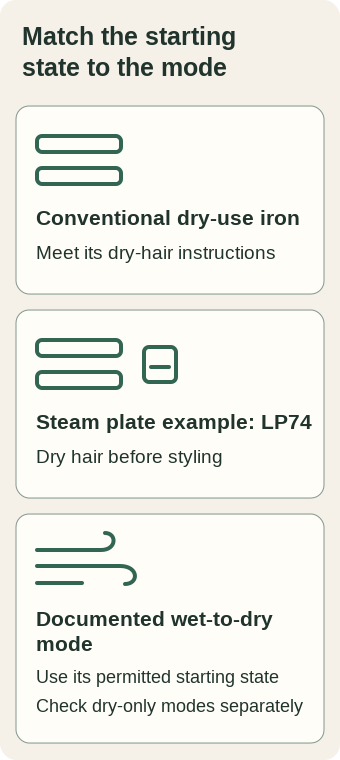
| Question | Conventional dry-use iron | Documented wet-to-dry system |
|---|---|---|
| Where does it enter the routine? | After its required dry-hair preparation | At the starting state permitted for its drying mode |
| What mechanism matters? | Contact between the section and plates | The exact airflow and contact arrangement |
| What must a refresh follow? | The iron's dry-use instructions | The separate permitted refresh mode, where supplied |
| What care must be planned? | Model-specific plate and exterior care | Contact surfaces plus the model's air-path care |
This table does not equate the tools' temperature scales, drying speed, finish or exposure. A numerical setting from one mechanism is not a transferable recommendation for another.
Keep mode permission attached to the mode
Duet Style's mode guide makes Shine Shot a dry-hair-only stage. A wet-to-dry name does not make every setting suitable for the initial drying task. Read the actual transition and ready sequence if that optional stage is part of your plan.
Use Airstrait versus Duet Style for the named pair. This category decision does not duplicate its product comparison or import controls from an older revision into a current listing.
Include handling, care and the resting area
Compare the route your hands need to follow around a section, the opening and controls, and a suitable place to rest the appliance between working areas. Use an unpowered display tool for access checks where possible. That rehearsal does not measure drying or the eventual finish.
Read wet-to-dry straightener care when assessing ownership. An air inlet introduces a different inspection task from wiping an exposed plate. A familiar pouch or travel setup also needs exact compatibility rather than an assumption based on the outline.
Keep steam as a separate question
A steam-fed plate tool is not automatically a wet-to-dry system. Steam straightener versus flat iron owns that choice. Identify what the model permits rather than sorting appliances by words such as air, steam or smooth.
Once the task is clear, use the corresponding wet-to-dry method or conventional flat-iron method. Choose a workflow you can follow and check which step a combined format would change.