Quick answer
Switch off, unplug and let the appliance cool. Identify the actual part and its permitted access, use only the documented cleaning method, and complete drying and refitting before reuse. A washable part on one revision does not make another filter washable, and drying hair does not make the electrical body safe to rinse.
Name the part before choosing a method
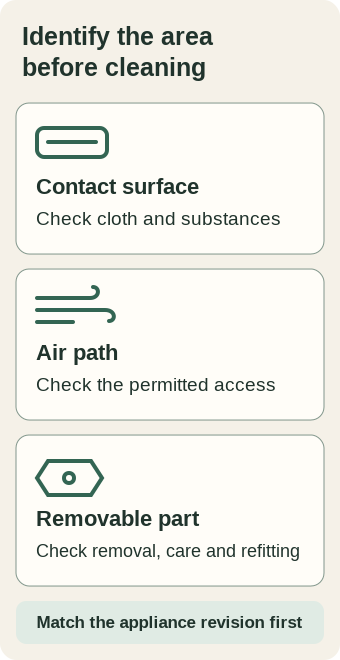
Find the care section for the exact model and market. Identify whether the instructions concern a plate, tension surface, air inlet, outlet or separately removable component. A seam, grille or clip-like shape is not enough to establish that you may open it.
Make a simple map of the instructed areas. If one area has no documented method, ask the maker about that area rather than extending a nearby part's permission. Ordinary straightener-plate care does not answer a wet-to-dry appliance's entire maintenance task.
| Care question | What the instructions must establish | What does not establish permission |
|---|---|---|
| Exterior surface | Cloth, permitted moisture and substances | Another model's cleaning video |
| Air inlet or filter | Accessible area and allowed cleaning action | A removable-looking grille |
| Detachable component | Release, cleaning, drying and refitting | Being made from a familiar material |
| Contact area inside the arms | Exact surface and care method | Resemblance to a flat-iron plate |
Keep the Duet Style example attached to Duet Style
UK Duet Style care support calls for unplugging and cooling, permits a damp exterior cloth and describes gentle soft-brush removal of dust and hair from the rear filter. It does not direct immersing the appliance.
Follow that model's illustrated access and handling instructions. Do not turn a rear-filter brushing instruction into permission to wash a detached-looking housing. Duet Blowdry is a different product; its barrel, bristles and care page are not substitutes for this model's instructions.
Resolve the Airstrait revision before filter care
The current UK Plum/Copper listing depicts an integrated comb. Its filter FAQ describes a soft dry cloth for outer-cage and inner-mesh debris. The same page points to detailed appliance support for other care tasks.
Do not combine that wording with an older filter-washing sequence simply because both documents say Airstrait. Match support to the serial/model and the part actually fitted. If the accessible instructions disagree about removal or washing, resolve the mismatch with Dyson before proceeding.
This guide therefore does not supply a shared soaking period, detergent, drying time or disassembly sequence. Those details are useful only when their instructions belong to the appliance in front of you.
Finish drying and refitting before powering again
Where the actual instructions permit moisture or removal, complete every specified drying and refitting step. Keep cleaned small parts away from loose debris while they wait to be refitted. Confirm the intended parts are securely seated by their documented method.
An unusually weak airflow, recurring fault or damaged fitting is not proof that a stronger cleaning method is needed. Stop for abnormal operation and follow manufacturer support rather than repeatedly powering the tool to test an improvised repair. Hair-dryer filter care is another appliance category, not a workaround for missing instructions.
Return to the correct styling sequence
After care, use wet-to-dry straightener operation with the same model instructions. Cleaning does not change the permitted starting hair state or make a dry-only mode suitable for drying.
Keep a short record of the area cleaned and any remaining observation. A named part and a clear symptom help a support conversation; a general request for a deep clean can conceal the actual access or fault question.