Quick answer
Consider T3 Curl X when selectable settings and its published long-barrel description address a requirement you want to investigate. Consider the original ghd Soft Curl when you prefer its preset control. Their shared nominal diameter does not make every dimension, instruction or finished curl equivalent.
Compare the right versions
This page uses the US T3 SinglePass Curl X listing, selecting its 1.25-inch variant, and the US original ghd Soft Curl listing. It excludes the older T3 SinglePass Curl, the Curl X BodyWaver and ghd Chronos Curve Grand.
Table: swipe sideways on a small screen, or focus and use arrow keys.
| Published distinction | T3 SinglePass Curl X, 1.25 inch | Original ghd Soft Curl, 1.25 inch |
|---|---|---|
| Holding format | Clamp | Clamp |
| Control approach | Nine heat settings | Preset 365°F |
| Barrel-length evidence on the checked listing | Maker labels the barrel 6.5 inches | No equivalent numeric length established by the cited page |
| Automatic shutdown statement | One-hour auto off | Sleep mode after 30 minutes of non-use |
These are source statements, not independently measured values. A shutdown interval is an ownership feature, not a reason to leave a powered tool unattended. The listed preset is a product fact, not a personal temperature recommendation.
Decide whether you want to select a setting
The T3 offers a selection task that the preset ghd does not. That can matter if you deliberately want documented options, but more options do not establish a better outcome. Review the exact manual and the control layout before regarding a setting count as a purchase advantage.
If you already own a tool whose controls suit your routine, identify the problem the alternative would solve. An extra dial is relevant when the interface is the unresolved requirement. It does not explain why a curl relaxes or a section was difficult to place.
Keep length evidence separate from diameter
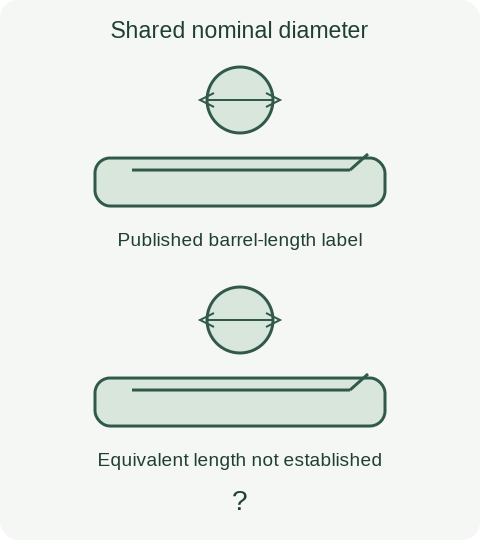
A 1.25-inch label describes nominal barrel diameter. It does not describe the room along the tool for arranging a section. The T3's published barrel-length label is useful evidence to retain, but it should not be converted automatically into a measured usable heated span excluding every tip and clamp boundary.
The absence of an equivalent number on the cited ghd page is an evidence gap, not proof that its barrel is shorter. Ask for comparable definitions before ranking available working space. The barrel-size guide explains these dimensions; the long-hair selection guide owns the broader section-planning decision.
Inspect clamp access and the release path
With a cool, unplugged tool where available, inspect the lever position, opening and route your hands would take. Keep the whole body and cable in that rehearsal. Two nominally similar barrels can still present different handling questions, and a product photograph cannot establish personal comfort.
For actual styling, use only the exact appliance's instructions. Do not borrow the other model's timing or turn the manufacturer's promotional result into a shared method. The clamp-iron tutorial is the next general step; a catch or crease calls for reviewing placement rather than pressing harder.
Make the purchase case specific
Write one reason for changing tools: a control interface you prefer, a documented dimension you need clarified or an ownership detail that matters in your routine. Check the exact selected variant and current seller terms after settling that reason. Keep missing information visible rather than filling the table with a related model's specification.
If the current appliance already supports manageable placement and release, replacing it is optional. This comparison does not establish a winner for curl duration, heat consistency, speed, shine or damage reduction. Those outcomes require evidence beyond a specification table.