Quick answer
Turn off and unplug the tool as instructed, allow it to cool fully and pack it in the permitted case or cover without straining the cord. Keep the plug and loose attachments from pressing against working surfaces. Check electrical compatibility and current travel restrictions separately; a compact shape or heat-resistant bag does not answer those questions.
Choose the routine before the number of tools
Name the styles you expect to repeat and which appliance performs each necessary task. If accommodation provides a suitable dryer, verify what is available before assuming you need to carry another. A supplied dryer may not have the attachment or control you use, so availability and usefulness are separate questions.
Use travel hair-dryer selection or travel flat-iron selection when choosing the appliance. This packing sequence begins after that choice; it does not rank travel models or establish that one kit suits every trip.
Finish electrical and carriage checks before packing
Read the exact appliance's rating and manual for the destination. Plug adapters versus voltage converters owns that electrical distinction. Do not infer voltage compatibility from a folding handle, small size or the word travel.
For a flight, check the airline and relevant departure, connection and destination requirements for the exact item. Battery-powered and gas-powered models need their own checks. For UK journeys, GOV.UK's electrical-items guidance is an official starting point and directs readers to additional airline and battery information. It is not a worldwide permission list for every cordless appliance.
Give cooling its own place in the departure plan
Complete the appliance's shutdown and cooling directions before closing it into luggage. There is no shared ten-minute or thirty-minute interval that proves every tool is ready. If you style just before checkout, allow enough time for the exact tool rather than relying on the bag's lining.
Cloud Nine's UK care guidance distinguishes cooling from putting its tools away. It also describes loose cable loops and keeping the plug away from a straightener's plates. Those are named care directions, not proof that every case or guard fits every appliance.
Lay out the cooled kit before closing it
Table: swipe sideways on a small screen, or focus and use arrow keys.
| Piece | Packing check | If it does not fit |
|---|---|---|
| Appliance | The exact case, guard or cover suits the model | Reconsider the case or tool instead of forcing closure |
| Cord and plug | There is room without tight wrapping or a pull at the connection | Change the arrangement and leave the connection relaxed |
| Removable attachments | Removal and separate storage are permitted | Follow the model's method rather than forcing a joint |
| Brush, clips or rollers | Contact surfaces and fastenings are protected from crushing | Use a suitable compartment or reduce the kit |
| Products | Containers and carriage arrangements suit the itinerary | Recheck the relevant carrier and security guidance |
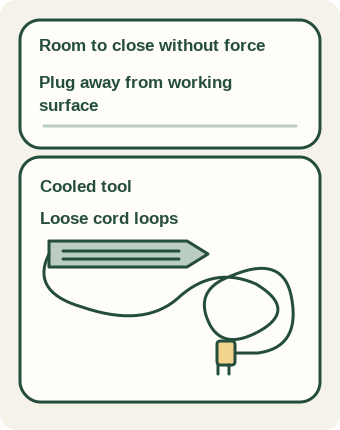
Follow the model's guard and cable directions. Do not copy a supplied straightener guard onto a dryer or use a zipper to compress an overfilled kit. Heat mat and pouch selection owns accessory fit; a new pouch is optional when the existing case already suits the task.
Loose manual accessories also need a deliberate compartment. For hair bungees, keep the hooks from catching other items; for hair sticks, protect the working tips and decorative joins from pressure. Their placement and care guidance does not establish carriage permission or a wash method for the rest of the kit.
For a steam appliance, complete its exact reservoir and storage directions separately from arranging the cooled cord and attachments. Steam-straightener care keeps that water-system question distinct from surface wiping. For an airflow straightener, revision-specific care also checks that required parts are clean, dry and refitted before the next session; a neat packed layout does not establish readiness.
Inspect the kit again on arrival
Open the case and check the working surfaces, attachments, plug and cord before use. A shifted attachment or pressure mark in a pouch is a reason to inspect the arrangement, not automatically evidence that the appliance is damaged. If the tool or cord is visibly damaged or operation is abnormal, follow the maker's service guidance rather than trying it repeatedly.
Set up a suitable resting area at the destination before switching on. Keep the packing checklist for the return trip too, especially if the final morning's routine differs from the outward journey.