A plug adapter changes the shape of the connection; it does not change voltage or frequency. Before taking a dryer, flat iron or hot-air brush abroad, compare the exact appliance input rating with the destination supply, then check the plug solution, adapter capacity and manufacturer restrictions. If a required fact is missing, stop and ask the maker or use a locally compatible appliance.
Read four separate pieces of evidence
Electrical Safety First explains that travel adaptors do not convert voltage or frequency and that their maximum power rating and earthing suitability matter. Its travel advice also distinguishes the supply, socket and exact appliance rating. A dual-voltage label means the stated input range may accept more than one supply; it does not promise that the plug fits, that an adapter is adequately rated or that a model with a different code shares the rating.
The US Revlon Salon One-Step listing says its unit is for 120 V US outlets only and explicitly says not to use a voltage converter. Follow that restriction. By contrast, the US BaBylissPRO BNT4172T listing states 120/240 V dual voltage; its plug and the exact destination still require a separate check. A charging set and the operating appliance can also have different ratings. Do not move one label onto the other.
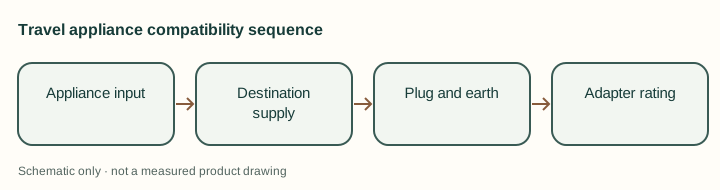
Hypothetical appliance label: “INPUT 100–240 V, 50/60 Hz, 700 W.” Record actual model and market → actual input from its plate/manual → destination supply from a reliable source → socket and earth requirement → adapter rating → manufacturer permission. These hypothetical numbers do not identify a real appliance.
Table: swipe sideways on a small screen, or focus and use arrow keys.
| Check | Evidence to write down | If missing |
|---|---|---|
| Exact appliance | Model code, purchase market, input voltage/frequency and maker directions | Do not infer from a family name. |
| Destination | Supply and socket information | Check an authoritative local source. |
| Adapter | Plug fit, maximum rating and earth support | Do not use an unknown adapter. |
| Converter | Only where the maker permits it and all ratings match | Never use to bypass a prohibition. |
Decide what to pack
If the exact appliance input covers the destination supply and the maker permits travel use, find an appropriate correctly rated plug solution. If the appliance requires a different input, a converter is not an automatic fix: first check the maker's instructions and the converter's suitability and rating. Some products prohibit converter use outright. If the information remains uncertain, a local compatible tool is the practical answer. The same decision applies to high-power dryers and low-power straighteners; neither wattage alone nor a “travel” label establishes compatibility.
For product selection after the electrical check, use the travel flat-iron guide or travel dryer guide. The wattage owner explains rated input power separately from unmeasured drying performance. Keep the rating-label notes with the exact unit you own; a replacement charger, different regional model or limited edition can need a fresh check.
A stop outcome is useful
Suppose an exact appliance label says 120 V only while the destination supply differs. An adapter can make the plug fit but cannot resolve that input mismatch. If the appliance maker prohibits converter use, the worksheet ends at “do not take this appliance for operation there.” Revlon gives exactly that restriction for the named US Salon One-Step. Do not search for a higher-rated converter to override it. Choose a locally compatible device or ask the manufacturer about a distinct regional model.