Quick answer
Use the exact formula's permitted starting state, quantity, placement and distribution method. Prepare manageable sections so you know which areas received the application. Before using an appliance, meet its preparation requirements as well as the product directions; do not infer readiness from the name heat protectant.
Read five fields before beginning
| Field | Record from the actual directions |
|---|---|
| Starting state | The wet, damp, towel-dried or dry state named for this application |
| Quantity | The stated dose, if supplied; no borrowed spray or pump count |
| Placement | The areas to cover and any exclusions |
| Distribution | The instructed hand, comb or other application method |
| Next step | Any drying or readiness requirement before the intended appliance |
If a direction is unclear, resolve it before regarding a general tutorial as permission. The selection guide explains how to compare candidate formulas; this page starts once you have identified the product and intended use.
Set out the application path
Separate the area you will work through so adjacent hair does not keep joining it. Keep already treated sections distinct from areas you have not reached. The aim is an orderly sequence, not a universal section count or an extra application to every visible strand.
Place the bottle where it is easy to pick up without losing track of the section. Follow any shaking, spray-distance or hand-application instruction on the container. A spray count from another nozzle or a pump quantity from another formula is not a transferable dose.
Apply and distribute as directed
Work through the planned areas using the product's actual placement instructions. Do not spray only the visible top while assuming the underlying sections received the same application. Equally, do not keep repeating an area just because it is the easiest one to reach.
Use the distribution method the formula directs and a suitable tool if one is needed. If a comb meets a catch, stop and resolve it rather than pulling through because product has already been applied. Sectioning for styling helps organise the boundary; it does not change the formula's dose.
Check readiness before the appliance
UK ghd heat-protection guidance describes waiting for the applied product to dry before direct-contact styling. That example illustrates why the handoff matters; it is not a universal drying time or a method for every formula.
Check the exact appliance too. A dry-use iron and a tool with documented wet-to-dry instructions can have different preparation requirements. Do not borrow permission from the second because both products use the word styling. A protection claim does not authorise a higher setting or override the appliance's restrictions.
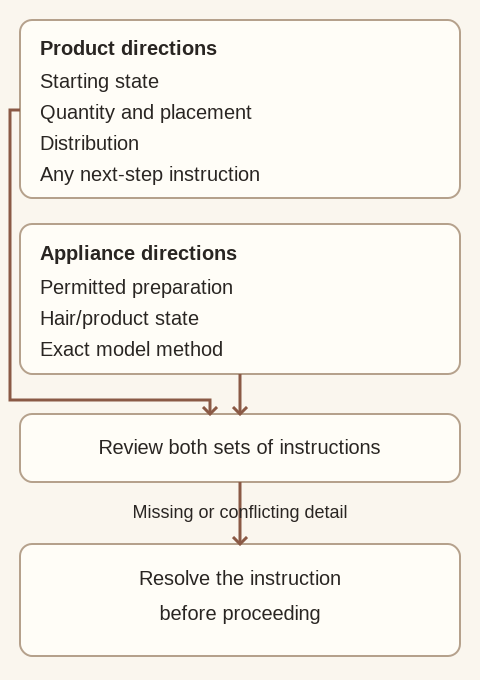
Keep a formula's application separate from an appliance's water system: steam-straightener preparation does not turn a heat protectant into reservoir contents. For a combined airflow appliance, the wet-to-dry method keeps the initial drying mode and any dry-only finish distinct. Product permission and mode permission must both fit the next step.
Review later restyling as another instruction check
If you blow-dry and then use a second tool later, review what the product says about that sequence. Do not assume either that the first application covers every later event or that another full application is always needed. Keep the formula and the later appliance instructions together.
For several products, hair styling product order separates their roles. A leave-in or finishing spray may overlap in advertised function, but that does not make every combination a documented method.
Review distribution before changing the bottle
If the finish feels concentrated in one area, note where application began and whether sections overlapped. If the sequence was difficult to follow, a different delivery format may be worth comparing in spray versus cream. Neither observation proves a protection failure or supplies a home test of thermal performance.
Keep the method simple enough to repeat. A useful application record names the exact product, the area and the next step; it does not need a score or a larger collection of bottles.
For a separate styling or finishing formula, use serum and oil application. That method does not infer heat protection from the product label or override the appliance restrictions used in this guide.