Name the task before making the partings
A section for working through a tangle is not automatically the right section for a brush-styling pass. Decide what the next movement needs: access to the ends, room to guide a brush, or an area you can cover with a product. This keeps the section plan connected to the task instead of copying a diagram made for a different routine.
Tangle Teezer’s UK blow-dry tutorial describes sectioning and clipping unused hair away from the working area. That supports the organisation step; it does not establish one section count or a heat setting for all tools.
Keeping a prepared fringe aside while getting ready is a smaller temporary task than parking an unused styling layer. Use creaseless-clip placement for that surface section. Keep its removal point separate from the next active tool path.
For the finished arrangement, banana-clip use, bungee use and hair-stick placement each begin with the section supported for a different mechanism. That is separate from parking unused layers while you style. The amount stored in one clip does not decide what another fastener should hold.
Separate, park, work and release
- Find the area you can comfortably reach and inspect.
- Separate it with your fingers or a suitable comb, without forcing through a catch.
- Park unused lengths with a fastening that holds them without pulling.
- Keep the fastener and unused hair clear of the movement you plan to make.
- Complete that working area, then release the next part deliberately.
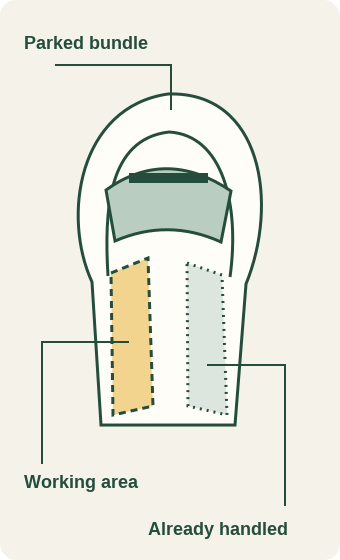
Use a mirror to check the back if you cannot see where the boundaries meet. The parked area should help you find the next section, rather than conceal a bundle you will have to rediscover later. If you cannot keep the boundary clear, divide the area again before starting the tool movement.
Choose the holding accessory for the layer being parked. Creaseless clips versus sectioning clips separates temporary surface holding from clearing a working layer, while sectioning-clip selection explains opening and contact checks.
Keep working sections different from storage bundles
A broad upper bundle may be convenient to park, while the area released from it needs to be smaller. There is no contradiction: one holds unused hair and the other gives access for the next movement. Release part of the parked bundle instead of assuming that everything held by one clip must be worked at once.
This also explains why buying a larger clip does not necessarily solve a crowded brush pass. The clip may already park the hair correctly. Review the amount you release and the route your hands take before replacing an accessory. The sectioning-clip selection guide owns jaw shape and mechanism choices.
For automatic-curler loading, keep the next permitted section separate from loose neighbouring strands; a clip holding a large parked layer does not set the chamber's loading amount. For waver use, preserve that working boundary while opening and repositioning down the section. The exact manual still sets each appliance's limits.
For wet-to-dry straightener use, keep the next drying section recognisable and finished lengths out of the way, especially if an optional dry-only stage follows. For steam-straightener use, the fitted parts and documented pass direction need their own working path. A clear boundary helps organisation but does not change either appliance's preparation requirements.
Adjust the boundary when the tool collects extra hair
Table: swipe sideways on a small screen, or focus and use arrow keys.
| What happens | Change to try |
|---|---|
| Neighbouring strands enter the working area | Re-establish the boundary and park those strands clear |
| You cannot reach the underside | Release a smaller part or change your working position |
| A clip slips | Review its placement and the bundle it is holding |
| Finished and unfinished areas become mixed | Choose an easier release sequence before continuing |
Start with a short trial area rather than committing the entire head to a complicated grid. Notice whether you can put the tool down, find your place again and continue. If that is difficult, simplify the boundaries. A repeatable plan is more useful than matching somebody else’s number of clips.
For airflow-barrel use, make the intended ends identifiable before attraction begins. For a powered rotating brush, keep the neighbouring layer clear of the head and its joint. These are different entry paths; neither makes a parked layer's full size the right working amount.
Record the part that made the routine easier
For the next session, remember where you started and how you identified finished areas. You might work through one side before the other, or release a lower layer from a parked upper bundle. These are examples of organisation, not a mandatory order. Keep the sequence that lets you reach each area without straining or repeatedly undoing previous work.
When an appliance is involved, first check its starting-state, accessory and product restrictions. A clear section does not override those instructions. If you are still deciding which stages belong in the routine, use hair styling product order before adding another step.