Quick answer
Read the exact formula's directions, prepare the required hair state and dispense its stated amount. Spread it through the intended area, then assess the coverage before adding another application. Consider a preparation step and a dry-hair finish as separate decisions rather than automatically repeating the same amount twice.
Identify the formula and the job
Check the full product name and version on the bottle. A pump, dropper or open bottle changes how you dispense it, but does not identify the formula's purpose. A product marketed as an oil can be a blend, and a serum can contain oils.
Use serum versus hair oil when the formula choice is unresolved. This method concerns applying a chosen leave-in styling or finishing formula. It is not a scalp-oiling routine or an instruction to turn a rinse-out product into a leave-in.
Separate two permitted stages
The UK Moroccanoil Original formula directions provide one named example. They describe a small amount through clean, towel-dried mid-lengths and ends, followed by the permitted drying method. The listing also describes a dry-hair finishing use. These are directions for that formula, not every bottle called serum or oil.
For any formula, establish which stage you are using now. A finished hairstyle does not need another preparation dose merely because the label permits more than one application state. Likewise, a dry-hair finishing instruction does not automatically authorise application before every heated appliance.
Apply with a clear coverage boundary
- Read the bottle's starting state, amount and placement instructions together.
- Identify the lengths or selected area you intend to style and bring the hair to the stated condition.
- Dispense the directed amount using that container. Do not equate one pump with a drop from another bottle.
- Complete any hand-spreading step the product specifies, then distribute through the intended area.
- Check whether the first section received most of the product and whether other intended sections were reached.
- Follow the permitted arranging or drying method. Assess the result before another directed application.
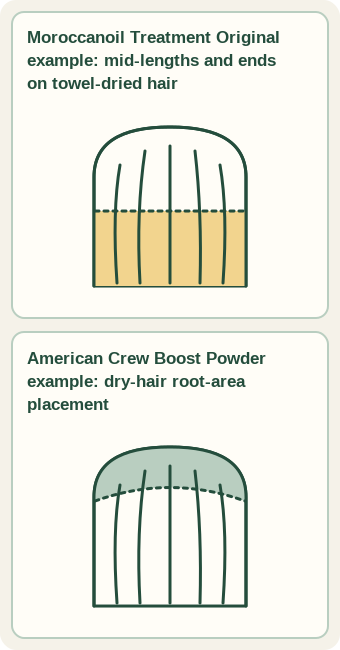
If the directions specify lengths and ends, keep that placement distinct from a root-area product. Adding the same formula at the roots is another use question, not a way to compensate for missed ends.
The UK Original and Light comparison keeps the two Moroccanoil formulas together. Their directions distinguish a small amount on towel-dried mid-lengths and ends from dry finishing. Start with the permitted stage and an area you can distribute over evenly before adding more.
Read uneven coverage before increasing the amount
Table: swipe sideways on a small screen, or focus and use arrow keys.
| What you notice | Check first | What it does not establish |
|---|---|---|
| One section looks more coated | Where the first amount landed | That every section needs another dose |
| Ends were missed | The intended coverage boundary | That a different ingredient is required |
| The finish feels heavier than intended | Amount, distribution and overlapping products | A verdict on every oil or serum |
| You are changing from damp to dry application | That formula's separate instructions | Permission to repeat the same dose automatically |
For another attempt, note the exact formula, stage and area so one change remains understandable. This is an editorial way to organise an observation, not a controlled friction or damage experiment.
Keep other products and appliances in the decision
Hair styling product order helps assign a job to each formula. A leave-in conditioner, cream and serum may overlap; keep another bottle only when it supplies a useful compatible step.
Read an appliance's preparation restrictions before applying a direct-contact tool to treated hair. A styling benefit on the bottle does not choose a tool temperature or override a product-free requirement. Use heat-protectant application for that separate product role.
Follow the exact formula's removal and storage directions. A change in shine or feel does not establish permanent repair of split ends or a change to the hair's structure.
For a styled curl set, decide how much separation you want before assuming that another serum or oil application is necessary. How to brush out curls covers that finishing choice. Any formula still needs a permitted stage and a clear role; the brush-out does not require another bottle.
For deliberately arranging an outline or individual pieces, wax use and paste use own those shaping methods. A jar with shine in its description does not automatically perform the same job as the serum or oil you selected. Identify the missing task before adding both.