Quick answer
Consider the Original Iron when its standard plate format gives you the access you need. Consider the Wide Iron when its wider format suits your working sections. Both checked listings share temperature options; width alone does not prove fewer passes or a better finish.
For the selected UK Original and Wide irons, both current listings give 100–240 V and hibernation after 30 minutes of inactivity. The gift dryer has its own rating. For a control choice at nominal one-inch width, use Original vs Touch.
Compare the current models, not similarly named variants
This page uses the UK Original Iron and Wide Iron listings. It does not substitute the Contouring, Cordless, Slim or Touch models, and it does not combine specifications from an older generation.
Table: swipe sideways on a small screen, or focus and use arrow keys.
| Published specification | Original Iron | Wide Iron |
|---|---|---|
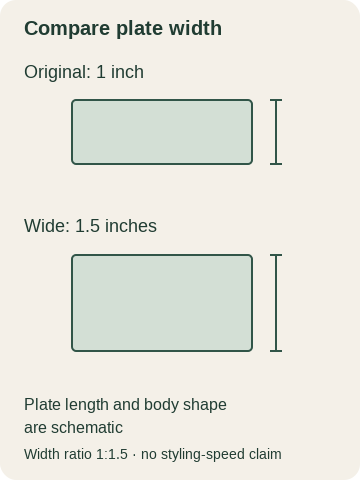
| Plate width | 1 inch | 1.5 inches |
| Temperature choices | 11 settings, 100–200°C | 11 settings, 100–200°C |
| Revive Mode | Listed | Listed |
| Cable | 3m swivel | 3m swivel |
| Published mass, excluding cord | 0.225kg | 0.278kg |
The weights use the manufacturer’s stated exclusion. Do not compare either figure with a shipping weight, a whole packaged set or a figure that includes a cable. The table is a specification comparison, not a measurement of comfort in the hand or a promise about the number of passes needed.
For an ownership comparison, note what you actually carry or hold as well as the published figure. A case and the cable are part of the bag you pack even when they are excluded from a specification. Likewise, an in-hand preference involves the route of the cable and your grip, not just subtraction between two numbers. Keep those practical questions separate from a manufacturer’s precisely qualified mass statement.
Choose width from access and the working area
Think about where the plates must reach. If a short section near your intended parting is difficult to place within a wider format, that access issue matters even when much of your hair is long. Conversely, if you prefer handling a broader prepared section, the wider format is a useful difference to examine.
Do not enlarge the section just to fill a plate. Start with the area you can control under the exact tool’s directions, then assess whether the format is convenient. The plate-width guide covers that general decision. This page identifies the documented widths of two actual candidates without assigning every hair type to one of them.
Shared controls are not a separate advantage
The listed temperature range and Revive Mode appear on both current product pages. They therefore do not explain why one width should replace the other. Identify which feature is genuinely different before counting the same control twice in a buying checklist.
A published setting is also not a recommended temperature for you. Use the exact manual and your routine’s restrictions rather than selecting the top of the range because it is available. This comparison does not prescribe a heat setting, contact time or product layer for either iron.
Keep the main iron separate from gifts and sets
Manufacturer pages can show other tools, styling sets and temporary gifts alongside the main product. Read the section headed for the exact iron you are considering. A specification shown under an advertised hot-air brush is not an iron specification, even when both appear on the same page.
For the same reason, confirm what the selected box contains before regarding an accessory as included. A bundle can change the purchase without changing the plate format. Keep the tool comparison and the offer comparison separate, so that a temporary gift does not hide the width decision you originally needed to make.
Write a practical purchase check
Before buying, identify one section that your existing iron makes awkward. Ask whether a different width would improve access or change the area you can conveniently handle. If possible, examine an unpowered display model for reach, opening and grip; do not regard that brief fit check as a result test.
If your existing iron already reaches the sections and arrangement you want, a second width is optional. Use the flat-iron selection guide for other candidates or how to use a flat iron when the unresolved question is method rather than another purchase.