Use plate width as a handling guide, not a rigid rule. The exact tool, your section size and your preferred control still matter.
Practical bands
- Narrow: under about 1 inch (25 mm) for bangs, short sections and precision.
- Standard: around 1 inch (25 mm) for versatile sections.
- Wide: around 1.5 to 2 inches (38 to 51 mm) for broader sections, with less close-section precision.
Use the Flat Iron Finder to apply these trade-offs.
Plate width is not the width of the whole tool
A product's plate label usually describes the contact strip, not the outside edge of the housing. A rounded body can be wider than the plate and may determine whether the iron can approach a short section comfortably. Look for a dimension drawing or exact specification; do not read a rounded US marketing inch and a UK millimetre label as a verified identical physical measurement.
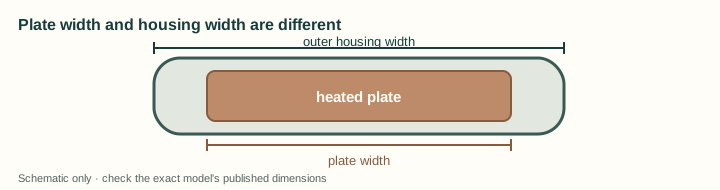
Outside housing │ margin │ heated plate width │ margin │ outside housing. The hand holds the body; the section touches the plates. Published plate width does not provide body width or usable plate length.
Table: swipe sideways on a small screen, or focus and use arrow keys.
| Label band | What it may help with | Trade-off to test |
|---|---|---|
| Under 1 inch, such as US ghd Mini 0.60 inch | Local short sections | More placements across broad sections. |
| About 1 inch, such as US ghd Chronos | Mixed ordinary sections | Neither the narrowest nor widest geometry. |
| About 2 inches, such as US Chronos Max | Broad sections | Less close-section precision. |
One inch converts exactly to 25.4 mm, but a manufacturer may round a regional label; the UK standard Chronos listing says 26 mm. Read those as labelled market descriptions until the exact measurement basis is established. Use the selection shortlist after choosing a practical width; a plate label alone does not prove speed, comfort or finish.
Use width to plan sections
Start with the shortest section you style routinely and the broadest one. A narrow plate gives room for the short task but asks for more placements on the broad task; a wide plate reverses that balance. The contact strip must cover the chosen section without hair escaping at an edge, while the housing must fit where you position the tool. These are two different measurements. If the product page gives only one, do not invent the other. A rounded exterior may make a turning motion possible, but its shape is not specified by plate width alone.
Convert units for orientation, then preserve each market label as written. Twenty-five-point-four millimetres is the conversion of one inch, not proof that a 26 mm UK listing was measured with the same convention. The same caution applies to 2-inch and rounded 50 mm labels. Compare exact standard and wide versions separately, because family names can cover multiple generations. The best width is the one that fits both your frequent section and your required precision; no width alone predicts finish or speed.
Make the final choice
Measure the section you want to handle and compare it with the maker’s stated plate width. Then look for body width, plate length and hinge access if those affect an edge section. A 1-inch contact strip may sit inside a larger housing. The width number helps narrow a shortlist, but the complete geometry decides whether you can position the tool where you need it.