Quick answer
Compare the oval AireBrush when you want to inspect a broad face and its curved edges. Compare AireBrush Round when a cylindrical head is the format you want to handle. The checked US listings share three heat settings, two speed settings and a cool shot, so head access is a clearer starting question than counting controls.
Keep the exact two models together
This comparison uses the current US AireBrush oval listing and AireBrush Round listing. It does not compare AireBrush Duo, a manual T3 round brush or an Aire 360 attachment.
Table: swipe sideways on a small screen, or focus and use arrow keys.
| Published detail | AireBrush oval | AireBrush Round |
|---|---|---|
| Model number | 76656 | 76657 |
| Head description | Oval | 2.5-inch round |
| Heat and speed choices | Three heat, two speed | Three heat, two speed |
| Cool shot | Listed | Listed |
| US operating-voltage listing | 125V | 125V |
The oval description does not supply an equivalent measured round diameter. Do not subtract a number from another brush listing and call the result an access advantage. The voltage row records these US listings; it is not permission to use either appliance on another supply.
Inspect the area that is difficult to reach
Name the problem section before comparing shapes: a face-framing piece, an area behind the ear, a lower layer or the ends of a longer section. Consider where the whole head and handle would travel, not only where the bristles touch. A head can fit under a section yet leave too little room to turn or move away.
With a switched-off, unplugged and cool display tool where available, inspect its outline, grip and control positions. You can also compare the published dimensions against the space your present tool occupies. This is a handling rehearsal; it does not measure heated performance or establish permission for a particular wrapping method.
Compare a face and an edge with a cylinder
An oval head presents different curves around its cross-section. A round head presents a circular cross-section. Those geometric descriptions help you decide what to inspect, but the exact bristles, working length and body can change the practical path. One shape is not automatically the smaller or easier option.
For a short piece, ask whether the intended working area can reach it without collecting a neighbouring section. For a longer piece, ask how the head will travel through and release the length. Do not assume a round head must be fully wrapped or that an oval head cannot shape an end. Follow the exact tool's method rather than deriving one from its outline.
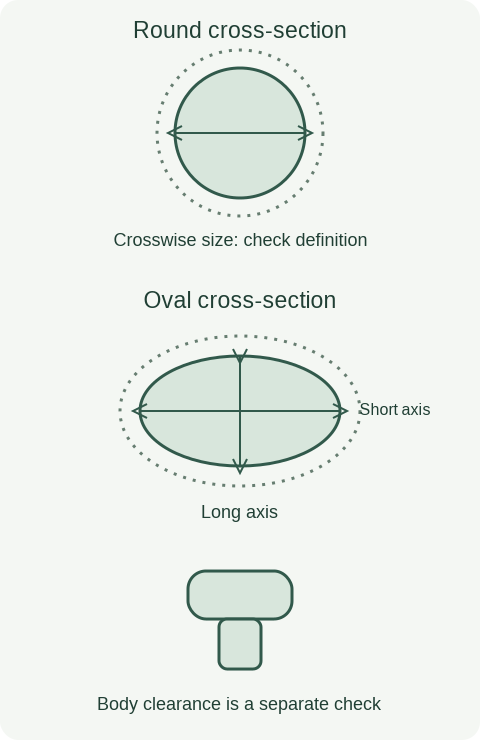
Separate head shape from rotation and attachments
A round profile does not by itself establish powered rotation. A separate replacement-head listing does not establish that these two complete appliances exchange heads. Check exact compatibility before buying an accessory; the AireBrush family name alone is insufficient.
Use rotating versus fixed hot-air brushes for the movement question. Use the barrel-size guide for measurement definitions and a side-by-side inspection worksheet. Keep those general decisions separate from the two models compared here.
Decide what the second brush would change
If your current head reaches, guides and releases the sections you repeat, the alternative is optional. If one recurring area remains awkward, write down the exact difference you need to inspect: body clearance, a reachable edge, a circular working curve or a more convenient grip.
Check the selected local model and its instructions before purchase. A US product page, a styling photograph and a retailer's bundle can describe different things. Neither shared controls nor a different head establishes a drying-time, comfort or durability winner. For the broader equipment decision, return to choosing a hot-air brush.