Quick answer
Check the empty clip's normal opening action, arrange a small section, place the open clip and close it without pressing it into the scalp. For removal, support the section and return the clip to its open position before sliding it clear. Do not force a distorted clip to snap back into shape.
Identify the piece in your hand
Accessory sets can contain pins and clips that look coordinated but open differently. The US Kitsch Sedona Metal Cloud Pins & Snap Clips set is a named mixed-format example. Its pack name does not mean every piece is operated with the same motion.
This method concerns the conventional bend-open snap component. If your accessory has a separate clasp, use barrette fit and release. For a two-arm pin, use the bobby-pin method. Do not bend an unfamiliar fastening simply because a shop calls it a clip.
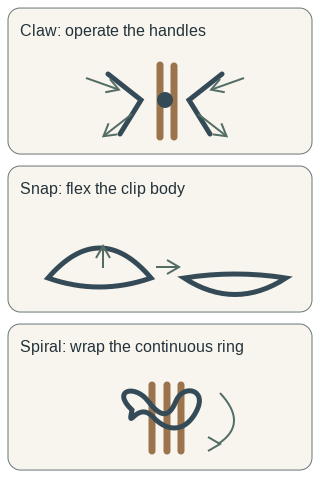
For a separate hinged clasp beneath a decorative front, use the barrette method. Do not bend a clasp barrette as though it were a snap body. Learn the actual release before positioning either accessory in the section.
If the accessory has long toothed sides and a separate catch, use banana-clip guidance. A click when it closes does not establish a snap clip's flexing mechanism. Keep the actual hinge, catch and intended release separate before copying a hand movement.
Practise opening away from the hair
Inspect the empty clip for rough edges, damaged covering and a body that stays distorted. Use its normal snap action with your fingers so you can see the opening and closure before placing it. This is familiarisation with the mechanism, not permission to reshape it beyond that action.
Keep decorative parts separate from the working body. A bow, cloud shape or coating can hide where hair will sit. Check the underside instead of assuming the decoration shows the usable holding area.
Place a small side section
- Arrange the piece you want to hold against nearby hair and keep it supported.
- Open the clip using the action you have already checked.
- Guide the intended section into the open holding area, keeping loose strands clear of the moving parts.
- Close through the normal snap action without pressing the accessory into the scalp.
- Ease away your hand and check the arrangement. Reopen and reposition if the piece slips or the contact feels uncomfortable.
Start with a manageable side piece rather than asking one small clip to carry a full bun. There is no universal section thickness or hair-length cutoff here. If the amount prevents normal closure, changing the section or fastening is a separate choice from pushing harder.
Separate contact problems from closure problems
Table: swipe sideways on a small screen, or focus and use arrow keys.
| Observation | What to inspect | What to avoid |
|---|---|---|
| Clip will not close normally | Captured amount and the condition of the body | Forcing the accessory against the head |
| It closes but the section moves | Placement and useful contact with that section | Assuming more decorative length means more grip |
| A strand catches at an edge | Loose hair and the condition of the contact surface | Dragging through resistance |
| The body stays bent | Whether it returns through its normal action | Using permanent deformation as an adjustment |
Make one placement change at a time so you can tell whether the arrangement or the accessory is the unresolved problem. A larger pack of the same clip may repeat the same mismatch rather than solve it.
Open fully before removal
Hold the section, release the normal snap action and guide the open clip away. If hair is caught, stop and separate it rather than pulling the closed piece down through the length. Check the accessory before storing it so a rough contact is not reused automatically.
For a temporary face-framing hold while getting ready, creaseless versus sectioning clips describes another task comparison. A snap clip can also be a visible accessory in the finished style; that is different from parking unused layers while styling elsewhere.