Start with the section you want to hold
Gather the actual side section or half-up arrangement before comparing barrettes. Notice the thickness at the fastening point after any folding or twisting. A barrette that works on two small side pieces may not close around a full gathered section from the same head of hair.
Decide whether the accessory will carry the arrangement or decorate a style already held by another fastening. Those are different jobs. Do not assume a decorative barrette can replace the main elastic in a ponytail simply because it covers it.
Inspect the fastening underneath
Table: swipe sideways on a small screen, or focus and use arrow keys.
| Part to check | Why it matters | What a listing cannot prove by itself |
|---|---|---|
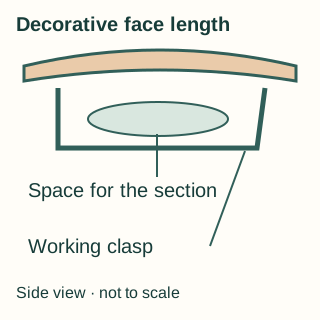
| Working clasp length | Shows where hair can sit under the mechanism | The outside decorative length does not equal this space. |
| Clearance when closed | Determines whether the gathered section fits | A “large” label is not a capacity measurement. |
| Contact with a small section | A very roomy clasp may not grip a small bundle usefully | A “fine hair” label does not guarantee hold for your arrangement. |
| Release mechanism | Must be accessible without pulling the hair | A front-only photograph may not show how it opens. |
| Edges and attachment points | Should not catch hair when opening or closing | A material name does not establish the finish of every edge. |
Names such as French clasp, automatic barrette and snap clip are used inconsistently. Look at the actual mechanism. This guide focuses on clasp-based barrettes; a small snap clip flexes open and shut differently.
Try closure before judging hold
- Open and close the empty barrette so you understand its release.
- Gather the intended section without stretching the clasp around it.
- Keep loose strands clear of the hinge and latch.
- Close the clasp using its normal action. If it resists, release and reduce or rearrange the section.
- Check comfort and whether the section stays in place during ordinary gentle movement.
- For removal, support the hair, open the clasp fully and move it away without dragging through the section.
Do not force the latch, remove a spring bar or bend the mechanism to create more room unless the maker explicitly documents that adjustment for the exact product. A broken clasp is not a fit adjustment.
Examples of different positioning
France Luxe describes its Essence Volume Barrette for fuller sections and its Long and Skinny French Barrette for a different profile. The labels help explain what to investigate; they do not establish measured capacity or guarantee hold.
Check the exact variant’s side and underside views before buying. If only the decorative dimensions are published, clasp clearance remains unknown. Use a suitable return policy or an in-person fit check rather than converting body length into an invented hair-volume rating.
If the barrette slips or will not close
If it will not close, reduce the gathered amount or choose a mechanism with suitable clearance. If it closes but slips, check whether the clasp makes useful contact with that smaller section. More outside length can make either mismatch worse if the working clasp still does not fit.
For a full twist, compare claw-clip fit or a French hair pin. For temporary styling sections, use sectioning clips. Keep an existing barrette if it already closes, holds and releases comfortably for the intended job.