Three pin shapes to distinguish
Table: swipe sideways on a small screen, or focus and use arrow keys.
| Format | What to look for | Main action | Useful limit |
|---|---|---|---|
| Closed bobby pin | Two arms resting close together; often one crimped side | Grip a small section between the arms | A thick bundle can spread the arms and reduce useful contact. |
| Open U pin | Two separated prongs, often made from relatively fine wire | Secure part of an already formed bun or twist | It does not clamp a loose strand like a closed bobby pin. |
| Rigid French hair pin | A more substantial two-prong body; dimensions and curvature vary | Pass through an arranged bun or twist | It needs a suitable path through that arrangement, not pressure into the scalp. |
Retailers sometimes use “hair pin” for all three. The photograph, prong spacing, rigidity and actual directions are more useful than the category name alone. A decorative top does not tell you which fastening mechanism sits underneath.
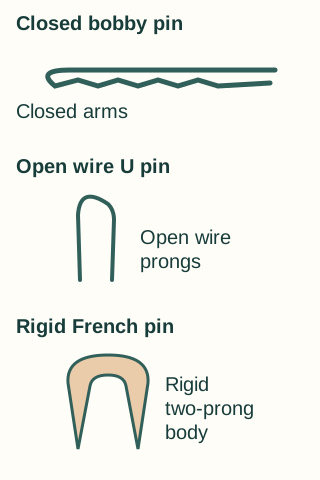
Choose by the arrangement
For a small side section that needs to lie against surrounding hair, start with a closed bobby pin that can close on the amount captured. For an already formed bun, an open pin may support part of the arrangement, while a rigid French pin may pass through a larger part of it. Neither is automatically a one-pin solution.
If you need to park unused hair during styling, a sectioning clip may be more convenient than either pin. If you want jaws around a gathered twist, use the claw-clip fit guide. Buying more pins does not resolve a mismatch between the fastening and the task.
Check the pin before comparing hold
Inspect the tips and contact surfaces. Set aside a pin with a rough edge, missing intended tip covering, corrosion or a distorted body. A bobby pin that remains spread after release should not be judged as if it still has its original shape. Do not bend a rigid French pin to make it fit.
Compare with the same arrangement and the same amount of hair. Changing from a small side section to a full bun changes the task, so it cannot tell you which pin is universally stronger. Release and reposition when a pin presses, catches or feels unstable.
Published examples clarify the names
Kitsch’s clips and pins guide distinguishes closed bobby pins from open pins used with buns and twists. Its Hematite French Hair Pin is a separate rigid format with its own use directions. France Luxe also sells a Small Hair Pin Pair, illustrating why pin size and construction should be checked on the actual listing.
These are examples of product naming and construction, not an independent hold test. Do not infer equal capacity from two products both being called a hair pin.
Continue with the method you need
Use how to use bobby pins for a small held section. Use how to use a French hair pin for a rigid two-prong pin and an arranged bun. The second tutorial does not cover every flexible wire U pin.