Quick answer
Prepare the hair as the exact gel permits, distribute the product through the area you intend to arrange and guide that area backwards with the appropriate fingers or tool. Complete the outline before the formula's setting stage. Fasten only if that is part of the intended style, without using tighter pulling as the way to obtain a smoother surface.
Decide what will actually be slicked back
Choose whether the backward direction concerns the whole style, the sides or a surface area leading into an optional ponytail or bun. The loose lengths can have a separate intended finish. A shiny upper surface does not require applying the same amount of gel to every lower length.
If your aim is to retain curl groups rather than comb hair backwards, use gel application for curly hair. That method owns a different shaping task. Neither method should be applied automatically because the bottle says gel.
Prepare the hair before asking gel to arrange it
Read the starting-state directions for the actual container. Resolve tangles before smoothing a surface into place; product and a finer finishing tool are not substitutes for preparation. Choose a comb or brush that can perform the intended pass without pulling through resistance. Brush versus comb helps separate those roles.
Plan the path before dispensing: the direction of any parting, the area you want to guide backwards and where the movement ends. Do not add a straightener or another heated step merely because a tutorial shows a very flat finish. Any appliance has its own preparation restrictions.
Keep the two named gel methods distinct
Table: swipe sideways on a small screen, or focus and use arrow keys.
| Maker directions | Starting-state detail | Later handling |
|---|---|---|
| American Crew US Firm Hold Styling Gel | Towel-dried hair, followed by distribution and arranging into place | Its method says to leave the arranged style alone |
| Give Me Cosmetics UK Slick Back Styling Gel | Wet or dry hair, hand preparation and finger/comb distribution | Natural drying with limited disturbance; its directions permit later reapplication |
Read the American Crew method or Give Me Directions section with the actual container. The second example's refresh permission does not establish that another gel should be rewetted, recombed or topped up after setting.
Distribute, arrange and then let the chosen method set
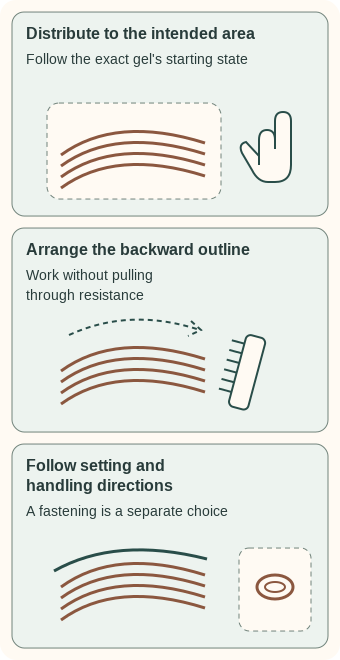
Apply the portion and hand preparation stated for the selected formula. Spread it through the intended region before finishing the visible outline. Keep track of the sides and any surface leading into a fastening, rather than depositing the entire first contact at the hairline and repeatedly adding more there.
Guide the prepared area in the chosen backward direction using controlled movements. Work only where the hair can follow the tool without resistance. If you see an uneven section, review coverage and the route while the method permits arranging, rather than pulling harder to obtain a flatter appearance.
Once the outline is where you want it, follow the product's drying and handling directions. Do not keep passing a comb through a setting formula simply to check whether it has become firm. A visibly wet-looking finish is also separate from the starting moisture state.
Keep fastening and surface finish as separate jobs
If a ponytail or bun is part of the plan, choose a suitable fastening and support the gathered lengths while placing it. Elastics versus scrunchies owns the fastening choice. Gel is not a reason to overtighten a tie or ignore pulling at the roots; loosen and rearrange a style that feels uncomfortable.
If the shape is intended to remain loose, no fastening step is required. Stop when the chosen outline is complete instead of adding a bun, extra gel, oil and hairspray to make the routine resemble another person's demonstration.
For a gathered tail, compare bungee and closed elastic handling, then follow the bungee method if that is the chosen accessory. For a toothed catch, use banana-clip operation. Neither fastening makes tighter pulling the way to improve the gel's visible finish.
Review a changed finish without stacking products
Note whether the issue was uneven distribution, the arrangement before setting or a later change. Those observations lead to different next checks. They do not prove incompatibility, product damage or a need for stronger hold.
Before adding a second formula or attempting a refresh, read the actual gel's directions. Wax versus gel covers a possible replacement; product order covers separate roles. Use the comb's own cleaning instructions when removing residue afterwards.