Start with the exact formula
Check whether the directions describe damp hair, a refresh application or another starting state. Read any accompanying preparation and finishing instructions.
Do not assume all gels require soaking-wet hair, create a firm cast or provide the same hold. Those are formula-specific questions.
Apply through manageable sections
- Prepare as directed. Keep any earlier products within the routine’s compatibility requirements.
- Divide the application area. Separate enough hair to see where the product is going.
- Use the stated starting amount. Keep that quantity tied to the exact product.
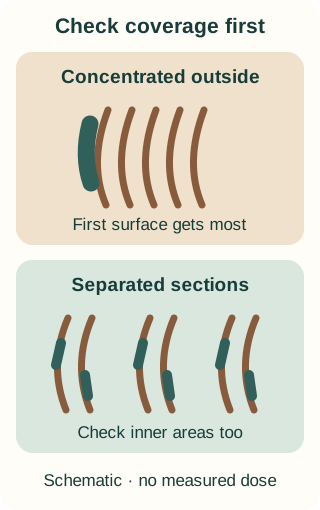
- Distribute using its method. Avoid leaving the whole amount on the first surface touched.
- Arrange the section. Follow the product’s shaping instructions without repeatedly disturbing neighbouring sections.
- Dry by a permitted method. Use the appliance’s own settings and restrictions if diffusing.
- Assess the finished application. Check whether the issue is missed areas, concentrated patches or an unwanted overall feel.
One product-specific method
Ouidad’s Advanced Climate Control Heat & Humidity Gel describes damp sections and its Rake & Shake method, with air drying or diffuser drying. This is a method for that formula, not a requirement for every styling gel.
Separate coverage from quantity
Plan how to reach the back and inner sections before starting the application. Keep completed sections distinguishable from those still waiting for product, using a sectioning arrangement that suits your routine. If you lose track, check the next section deliberately instead of applying another layer across the whole outside. Note which areas were awkward to reach so you can change the sectioning on another attempt. The goal is to understand where the product went, without assuming that every section needs an identical portion.
If the outside feels coated while inner areas appear untouched, first investigate distribution. Adding more over the same outer layer may repeat the imbalance.
If coverage is even but the overall feel is unwanted, compare the amount and other products used. If a simpler application still does not suit your preferred finish, another formula or format may be more useful.
Do not infer the cause of residue or a texture change from appearance alone. Follow the product label and its warnings.
Compare sections at the same stage
A section you have just arranged and one that has completed drying are not ready for the same judgement. Finish the permitted routine before comparing coverage and feel. If one area differs, note whether it was an inner or outer section and whether you could reach it easily during application. Use that observation to plan the next session’s sections. Keep the formula and drying method similar while reviewing distribution, rather than introducing another gel and several new layers at once. This is a way to make the comparison understandable, not a promise of matching curls across the whole head.
Do not assume a finishing step
Some routines describe changing the feel after the gel has dried. Follow the particular product’s directions rather than assuming every gel needs the same handling or an extra oil layer.
Compare mousse and gel if the format remains uncertain. Use product order before combining additional steps.