Compare roles rather than container shapes
Table: swipe sideways on a small screen, or focus and use arrow keys.
| Question | Leave-in conditioner | Curl cream |
|---|---|---|
| What job should you investigate? | Conditioning, preparation and manageability | Styling, definition and the intended finish |
| Can it also offer other benefits? | Some formulas do | Some formulas do |
| Does a creamy texture identify its role? | No | No |
| Does the name establish heat protection? | No | No |
| Must it be combined with the other category? | Not automatically | Not automatically |
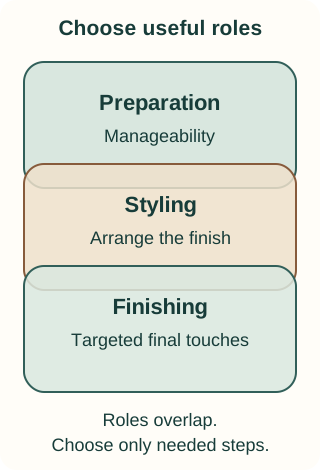
A spray can be a leave-in conditioner, and a cream can combine conditioning and styling claims. Read the formula’s own description and application instructions.
Identify what your current routine lacks
If preparation feels awkward before styling, investigate a suitable conditioning or detangling step. If the prepared hair is manageable but you want a different styled finish, investigate the styling product and application method.
Do not add a second product solely because a routine diagram contains another bottle. Two products that repeat the same job may add complexity without solving the issue you noticed.
Two products illustrate separate directions
Moroccanoil’s UK All in One Leave-in Conditioner describes application to clean, towel-dried hair before preferred styling products. Its Curl Defining Cream has its own towel-dried application and styling directions. These are named examples, not a universal instruction to use both.
Keep quantities attached to the exact formula. A pump from one container is not a transferable dose for another product.
Keep a role only when it solves your task
Imagine that your current leave-in makes preparation manageable, but the finished shape is different from the one you want. That is a reason to investigate styling directions, rather than automatically replacing the preparation product. Conversely, if arranging the hair is difficult before you reach the styling step, another styling cream may repeat the wrong job. Write down what each proposed bottle is meant to contribute. If both entries describe the same step, compare using one before planning a combination. Keep the exact product labels available while trying the routine so a familiar texture does not become a substitute for its directions.
If you want to use both
Compare the placement instructions as well as the product roles. One label may describe application through the lengths, while another may specify a particular area or styling step. Record those differences before beginning, rather than spreading both products everywhere because they share a creamy texture. If one bottle replaces a step in your current routine, remove that overlapping step from the comparison. Otherwise, you are assessing an added layer rather than finding out whether the replacement performs the job you need.
Check that their starting-state requirements and styling methods agree. Try the simpler routine first, then introduce the second product on another session while keeping other steps similar.
If the finish feels coated or uneven, review distribution and overlapping product roles before adding another layer.
Use hair styling product order to organise the sequence. For selecting a conditioning format, continue with the existing leave-in conditioner guide.