Use a flat iron for curls only when the exact model supports that movement: take a controlled section, make the documented turn, keep travelling and release without holding the plates stationary.
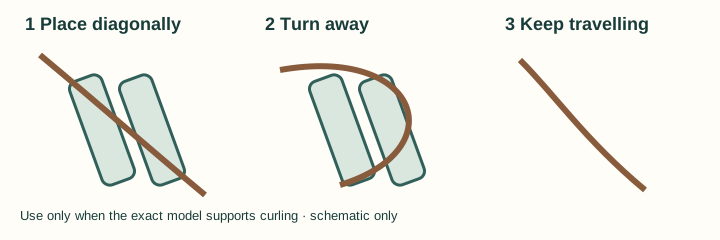
Set up the supported example
The current ghd tutorial uses the ghd Max on prepared, divided hair, places the tool diagonally, turns it away from the face, then glides along the section. That is an attributed method for that tool—not proof that every plate shape or rounded case is intended for curling.
- Confirm permitted hair state and curling use for the exact tool.
- Detangle and clip unused hair away from the plates and hinge.
- Choose a section that lies flat in the usable contact area.
- Practise the face-relative turn with the cold, unplugged tool if the mirrored direction is confusing.
Turn, keep moving, release
Place the supported tool at the tutorial's starting point, angle it as directed, and turn away from the face on that side. Continue travelling down the section rather than making a stationary clamp. Release at the end and let the formed section cool before dressing. Formation happens during the turn-and-travel path; later opening is a retention question, not automatic evidence that another hot pass is needed.
| Sign | Check | Change |
|---|---|---|
| Hard crease near start | Tool paused after turning | Reset the movement cold, then use a continuous supported path. |
| Section snags | Plate edge, residue, hinge or crowded section | Stop and use the mechanical inspection guide; never pull through. |
| Turn disappears | Rotation was released before travel | Practise turn and travel as one motion without adding heat. |
| Curl opens after brushing | Cooling and dressing sequence | Change one later variable and record the observation. |
Use ordinary straightening technique for a straight pass, the format comparison to decide whether another tool is warranted, and the retention troubleshooting timeline if the formed curl opens later.
Evidence: the current US ghd flat-iron curl tutorial names Max and documents diagonal placement, a face-relative turn and continued glide. Its advertised finish is not independently verified here.
Separate direction from finished appearance
Face-relative direction is a navigation aid, not a promise of a named style. On the left and right, an “away” path looks opposite in a mirror even though each section travels outward from the face. Use the tool nose and face as landmarks, then practise with the unplugged tool until turn and downward travel remain connected. Avoid one clockwise instruction for both sides.
Compare one trial section. A hard line at the start points to the pause and entry angle. A curve that disappears through the length points to whether the turn continued during travel. A shape that forms and later opens belongs to the cooling and dressing sequence. These observations separate movement from retention without prescribing more heat, a pass count or an outcome.
Keep the plates and hinge clear
Unworked hair, clips and the free end must stay outside the hinge and plate edges. Rest the tool only where its instructions permit. If a catch repeats, stop and inspect the cool tool; do not pull it down the section. Discontinue use for visible damage and follow the maker support process rather than an improvised repair.