Quick answer
Remove loose hair gently, inspect the roller and follow its maker's cleaning directions. For a heated set, disconnect it and let it cool before maintenance. Wash only parts whose instructions allow it, then complete the specified drying before storage or reuse. Do not turn a removable roller into proof that the electrical base can get wet.
Sort the pieces before choosing a method
Lay the set out away from a plugged-in appliance. Identify the roller body, its covering, the fastener and any electrical setter. Check the model name and care section rather than relying on a shop's broad label such as thermal or soft roller.
Table: swipe sideways on a small screen, or focus and use arrow keys.
| Part or construction | First question | What must stay separate |
|---|---|---|
| Self-grip roller | Does this exact covering and core permit washing? | A wash instruction from another brand or size family |
| Foam or fabric-covered roller | What care is specified for the covering and internal structure? | Assumptions that softness means machine washable |
| Roller from a heated set | What does its manual permit after cooling? | Care of the powered setter |
| Clip or pin | Does its finish and mechanism have separate care? | Permission to wash everything together |
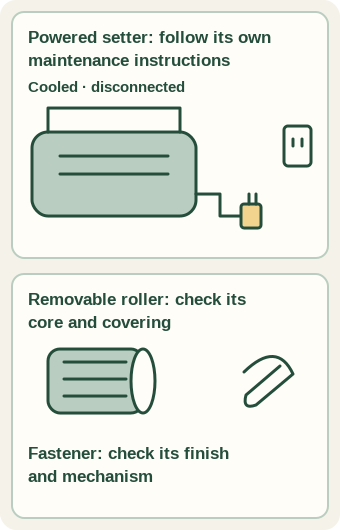
For fastening pieces, use clip and pin care. Keep the set's own manual available while sorting; similar-looking components are not necessarily interchangeable.
Remove loose hair without pulling at the covering
Lift away strands that come free easily, working a little at a time. Keep the roller supported so you can see where hair catches. Avoid forcing a sharp point under a covering or pulling hard enough to loosen its edge.
Inspect as you go. A damaged covering, exposed rough edge or distorted fastener is a separate finding from residue on an otherwise intact surface. Cleaning does not repair a damaged part. Check replacement options with the maker instead of disguising the damage under another layer of fabric or adhesive.
Follow a named care method only for that set
The Conair HS11RX manual separates a cooled, disconnected setter from its rollers. It describes wiping the unit and using a damp cloth with mild detergent or soap for the rollers. That is a wiping instruction, not permission to immerse either part.
The US Kitsch Ceramic Thermal Rollers listing supplies a different named example: its cleaning FAQ allows damp wiping and a deeper hand wash using mild shampoo, followed by rinsing and complete air drying. Keep that permission attached to the named rollers rather than extending it to every self-grip or foam set.
Complete drying before putting the set away
Follow the specified drying method for every part that has been dampened or washed. A dry outside surface does not establish a universal drying time for a covered or hollow item. Do not close damp pieces into the storage case or use an electrical setter as an improvised dryer.
Reassemble only as the set permits. Keep the clips with their intended rollers without forcing them onto a covering while it dries. For the next styling session, return to the heated-roller method or the self-grip roller method; cleaning directions do not change the starting hair state those methods require.
Make inspection part of putting the set away
Check for loose hair and visible residue after use so you can plan the appropriate care before the next session. There is no shared weekly soaking schedule here. If the maker gives a schedule, follow it; if the care instructions are missing, ask before introducing immersion, alcohol, vinegar or another cleaning agent.