Quick answer
Consider CoolShine when you want a corded setup and its removable cooling feature answers a specific straightening task. Consider the original Corrale when cable-free movement is useful and you accept charging and battery management. Keep a working iron when neither change addresses a problem in your normal routine.
Weighing CoolShine against Dyson’s wet-to-dry Airstrait rather than the original Corrale? Use Airstrait vs Corrale CoolShine.
Compare power before the cooling feature
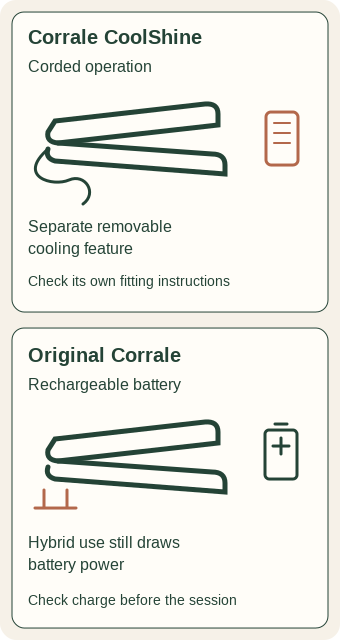
The CoolShine FAQ explicitly states that it is not battery-powered. The original Corrale listing describes a rechargeable battery. This is a meaningful operating difference even before considering the plate and attachment descriptions.
Table: swipe sideways on a small screen, or focus and use arrow keys.
| Decision | Corrale CoolShine, UK Ceramic pink | Original Corrale, UK blue/copper |
|---|---|---|
| Power arrangement | Corded; maker says not battery-powered | Rechargeable battery; cordless styling |
| Selectable settings | Four documented positions | Three documented positions |
| Cooling accessory | Removable heat-extracting attachment documented | Do not assume that accessory fits this generation |
| Ownership task | Plan the cord and attachment changes | Plan charge availability and the styling session |
The table describes available controls, not personal temperature advice. An additional position is useful only when it serves a permitted choice you intend to make.
Give the removable part a defined role
Dyson describes the CoolShine attachment for straight styles and removing it for curls. That makes attachment handling part of the decision if you want both kinds of finish. Check the exact fitting, removal and cooling instructions before making the change a routine step.
Do not buy the part for an original Corrale based on family resemblance. Compatibility needs an exact maker-confirmed pairing. A photograph showing a similar plate body is insufficient, and this comparison does not establish a retrofit route.
The word cooling does not turn CoolShine into a wet-to-dry appliance. Its FAQ specifies dry-hair use. For an appliance intended to combine drying and straightening, use Airstrait versus Duet Style and keep that separate starting-state decision intact.
Compare the routine around the appliance
At a fixed styling station, trace where the cord would run as you reach different areas. If it stays clear and the existing iron already suits the task, cable-free movement may add little. If the cable repeatedly obstructs the movement, decide whether managing a charge is an acceptable trade-off.
For the original Corrale, UK support says attached-cable hybrid use extends the session while still using battery power. Do not assume it provides an ordinary mains bypass. Corded versus cordless straighteners owns that general operating comparison.
Judge the offer using consistent evidence
Check the full selected box, including any case, mat, charging equipment or cooling attachment. A related accessory shown for sale does not prove it is included. Compare the current total only after verifying the parts you actually need; a discount does not supply a missing use case.
This comparison does not rank weight, damage, shine or retention. Published weight figures can cover different combinations of appliance, cord and accessory, while promotional outcome claims have their own conditions. Inspect the actual handling where possible rather than converting those figures into a guaranteed comfort improvement.
For travel, repeat the travel flat-iron checks for the exact model and trip. A maker's hand-luggage statement is not a complete answer for every carrier, route or electrical supply.
Travel lookup: use a different manual for each Corrale
The UK Ceramic pink CoolShine specification lists 100–240 V. Its English CoolShine manual on Dyson’s German host has four settings, a heat-extracting attachment and a universal-voltage travel statement. This is the corded model; an original Corrale battery checklist is not its operating procedure.
The original HS00 Corrale manual, page 5 instead tells the owner to contact the airline in advance, remove the Flight-ready tag before security, leave it disconnected during flight and carry the straightener in hand luggage. It also gives a Japan restriction. These are manufacturer instructions, not a current approval for a particular carrier or itinerary.
Identify which model you are taking, check its unit and charging-set ratings separately where relevant, and confirm current carrier and destination rules before travel. Switch off and allow the appliance to cool as its own manual directs before packing. For a corded CoolShine trip, the voltage statement still leaves plug shape and the adapter’s suitability to check. No airline-specific permission is asserted here.