Quick answer
Consider D3 when its styling-head format suits the local section you control. Consider D38 when the broader cushioned paddle serves a repeated task. If a brush already handles that section comfortably, shared pin language alone supplies little reason to add another. The main choice is head construction and access.
Compare the documented choices
Scroll sideways, or focus the table and use the arrow keys.
| Named UK field | D3 Original Styler | D38 Power Paddle / Detangler |
|---|---|---|
| Head format | Original seven-row styling head | Broader paddle body |
| Pin description | Original styling pins | D3-style pins in staggered arrangement |
| Pad description | Use exact D3 construction record | Air-cushioned pad described |
| Handling question | Local section and access | Broader head and steering |
| Working dimensions here | Unmeasured | Unmeasured |
| Replacement pad cross-fit | Not established | Not established |
Compare the head construction
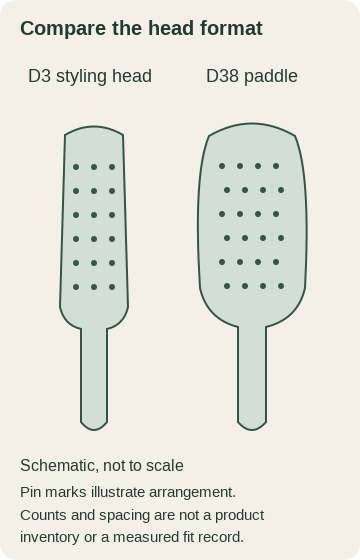
Denman describes D38 through its relationship to D3-style pins and its air-cushioned paddle format. D3 is the seven-row Original Styler. A shared pin description identifies one part of the construction. It does not make the complete heads identical. The original drawing below separates the narrow styling silhouette from the wider paddle without assigning either a measured width or engineering cutaway.
Match the head to the section
A narrower styling head can be considered for a local section where access matters. A wider paddle raises a separate question about the amount of hair presented and your ability to steer the head. Those are editorial handling interpretations. Try the movement against the section you actually want to control before regarding a broader outline as a reason to increase section size.
Why shared pins do not settle handling
Pins interact with the pad, head shape, grip and the section placed on the brush. The D38’s staggered arrangement and air-cushioned description belong to its named construction. They establish neither a universal detangling result nor a timed advantage over D3. A similar pin reference cannot approve replacement-pad interchangeability. Keep an exact spare code and compatible-body statement beside any replacement order.
Keep the Denman choices distinct
Use D3 versus D4 for seven-versus-nine-row selection. Use D3 versus D31 for the different spacing of two seven-row models. This D3/D38 decision concerns the paddle body. Do not derive a width, row count or replacement approval from a model suffix, or carry dimensions from D83 onto D38 because the codes resemble each other.
Identify the task before another brush
Begin with what you want the brush to do, such as detangling a prepared section or guiding a styling movement. A named brush may appear in more than one routine without making those jobs identical. The curl-defining and detangling format guide helps separate those tasks. Choose the permitted starting state and handling method from the exact product’s directions.
Check what the current brush leaves unfinished
If an existing brush already lets you reach, guide and release the section, another head may repeat the task. A paddle becomes worth comparing when a broader surface changes the handling you want. Before buying, compare the actual head and grip in the orientation you use. Working dimensions, comparative speed and finish retention remain unmeasured, so they cannot settle the choice here.