Quick answer
Consider an interlocking banana clip when you want its elongated sides to gather the selected hair and can reach its catch. Consider a spring claw when its jaws can surround the intended arrangement and close normally. Choose by that actual fit and handling, without assuming one format holds longer or is kinder to every reader's hair.
Name the moving parts
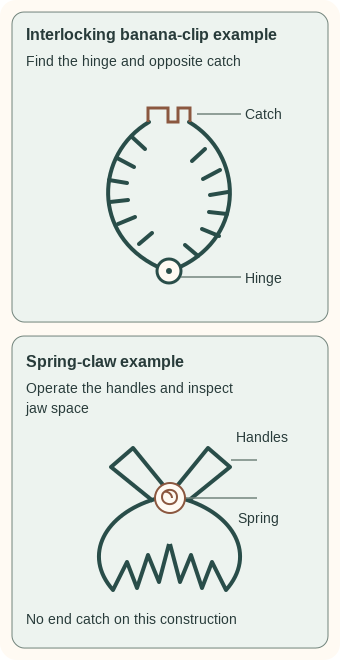
The France Luxe Banana Clip is a named interlocking-clasp example. The maker's Jumbo Couture Claw Clip – Classic is described with a spring clasp. These establish two physical constructions, not a controlled comparison of comfort, grip or wear time.
Check the actual accessory in your hand. A shop's banana or claw label does not replace an inspection of the catch, hinge, jaws and teeth. A different design within either broad category may need a different opening movement.
Compare closure and placement separately
Table: swipe sideways on a small screen, or focus and use arrow keys.
| Question | Named interlocking banana construction | Spring-claw construction |
|---|---|---|
| What closes? | The catch joins the ends of the toothed sides | The spring returns the jaws around the arrangement |
| What access matters? | Room to position the sides and reach the catch | Room to operate the handles and place the open jaws |
| What must be checked? | Alignment, closure and clear strands | Jaw opening, tooth contact and normal closing |
| What remains unknown from outside length? | Usable space for the selected bundle | Usable space for the selected bundle |
A catch failing to meet and a spring jaw held open by too much gathered hair are different observations. Do not solve either by pressing the accessory into an unwilling position. A smooth closure still needs a separate check that the arrangement is held as intended.
Begin with the arrangement you will actually wear
Gather a partial section, tail or twist before judging the accessory. The same person can put very different amounts of hair between a clip's teeth depending on the style. Hair length by itself cannot decide the required opening or contact.
For a banana clip, think about where its elongated sides would sit and how you would reach the catch. For a claw, think about the gathered volume, jaw route and handles. If the accessory blocks the intended placement or presses where you want to rest your head, consider a different position or fastener rather than a stronger closure.
Keep outside dimensions separate from usable space
A published length can help screen a purchase, but it is not an internal-capacity measurement. It does not specify how far the clip opens, how the teeth meet around your arrangement or whether you can operate it in that position.
Use claw-clip size and hold guidance for that reading of a listing. Keep missing measurements unknown. A larger number is not automatically an improvement when the unresolved problem is access to the catch or the shape of the working space.
Compare handling without manufacturing a winner
Where you already own suitable examples, compare the intended arrangement rather than two unrelated hairstyles. Note closure, placement and release separately. A clip that works for a partial section remains useful even if a different arrangement needs another accessory.
Do not report a preferred movement as evidence that the whole category causes less damage, holds for a particular duration or prevents dents. Neither the maker descriptions nor this editorial comparison establish those outcomes. Choose a change that addresses the actual task rather than replacing a working clip for a size or trend label.
Continue with the selected method
Use banana-clip operation or claw-clip operation for the chosen closure. Both begin with a supported arrangement and end by opening before withdrawing the accessory; their actual opening actions remain different.
If the selected section would instead suit a clasped barrette, use barrette selection. A third mechanism needs its own method, not a mixture of the banana catch and claw handles.