A hot-air brush can be useful for fine hair when the routine prioritizes control over force. When the exact appliance permits damp-to-dry use, begin in the towel-dried rather than dripping state its instructions describe; use smaller sections and select a setting that lets you guide the brush steadily. The aim is a smooth, light finish with direction at the root—not an ultra-flat result created by repeatedly brushing the same area.
Small changes have a visible effect on fine hair. A narrower section, less downward angle or gentler turn at the ends can change the overall shape, so adjust one thing at a time instead of increasing every control at once.
Fine strands can still make a crowded section
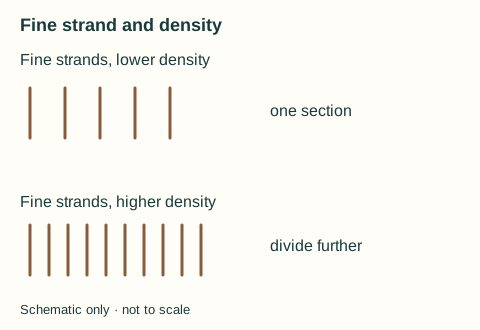
Start with a section you can see through well enough to guide over the head without repeated catching. If the strands are fine but there are many of them, split the section; do not assume that a hotter setting or wider head follows from density. The US Revlon Volumizer Plus has labelled low, medium, high and cool settings. Those controls let a user adjust within the appliance directions, but they do not form a universal fine-hair heat rule.
| What you observe | First method change |
|---|---|
| Root falls flat while length is shaped | Make a separate root-direction pass before smoothing the length. |
| Surface looks dry while underneath is still damp | Check the model's starting-state permission and divide the section. |
| Short ends escape the head | Use less hair or a smaller permitted working head. |
A dry-use heated brush belongs only after its own permitted preparation; use the format guide when deciding whether airflow or later dry finishing is the task.
Start in the state the exact appliance permits
Read the instructions for your exact appliance first. When it permits damp-to-dry use, hair that is towel-dried rather than dripping is easier to divide into manageable sections. A dry-use heated brush needs a separate permitted drying stage. If there is still a lot of moisture at the roots or underneath, a brief pre-dry can make the brush stage more consistent. Detangle before you begin: a hot-air brush should guide a section, not pull through knots.
Use smaller sections than you expect
| What you want | Section approach | Brush movement |
|---|---|---|
| Gentle root lift | Narrow crown sections | Lift briefly at the root, then move through |
| Smooth lengths | Sections no wider than the barrel | Use a calm root-to-end pass |
| Soft end shape | Keep front pieces separate | Make a small turn only at the ends |
Clip the upper layers away and begin underneath. Take a section that the barrel can hold without stretching it tight. Fine hair can look dry on top while the hair beneath needs more airflow, so smaller sections save automatic repeat passes and make it easier to see when a section is finished.
Lift first, then smooth the length
Place the brush close to the root of a lower section and lift the hair a small amount away from the head. Hold that direction briefly, then guide the barrel through the middle and ends. Keep tension light. Pulling the hair firmly downward can remove the movement you wanted at the root.
For a soft finish, guide the barrel steadily to the ends and use only a small turn in the final part of the pass. Let a completed section cool for a moment, then separate it with fingers before deciding whether any extra work helps.
Choose settings for control
Start with a setting you can hold comfortably and adjust only if a section needs it. Higher heat or airflow is not automatically better for a small, manageable section. A measured setting gives you time to direct the brush and move on before the hair is overworked.
Common fine-hair problems
| Problem | Likely cause | Try instead |
|---|---|---|
| Roots are flat | The brush started halfway down | Begin closer to the root and lift slightly |
| Ends look too curled | The barrel turned too far | Use a smaller finishing turn |
| The style looks limp | Sections were repeatedly smoothed | Stop after a clean pass and let it cool |
| The barrel catches | The section is too large | Reduce the section and keep the pass straighter |
Choose a routine that fits the result
A hot-air brush suits a brush-led routine from damp hair. If your hair is already dry and you only want to tidy the lengths, a straightening brush may be more direct. Compare categories in our hot-air brush versus hair dryer guide. For buying considerations, see hot-air brushes for fine hair and our Hot-Air Brushes hub.