Root volume comes from drying the hair in a direction that lifts it away from the scalp, then allowing that position to cool briefly. The round brush matters because it holds the root where you want it while the dryer does the drying. You do not need to pull hard or use oversized sections; smaller, controlled sections create more reliable lift.
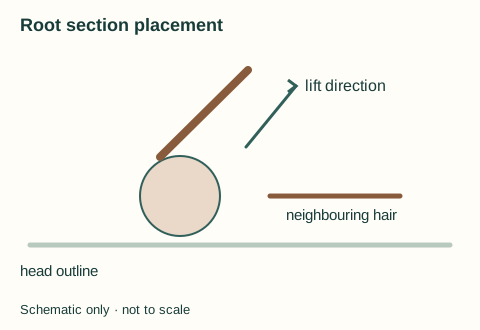
Try the crown strip before committing to a whole blow-dry. If a large barrel cannot sit under the root without catching neighbouring hair, a smaller brush or narrower strip is more manageable. If the strip wraps too tightly for the desired broad lift, test a wider curve once the section itself is under control. Density changes how many strips you work through, not a mandatory diameter. See the size owner for the barrel-versus-bristle distinction.
Pick a barrel that can reach the root
The best barrel for volume is not automatically the largest one. A very large brush gives a broad, soft shape but can be difficult to place close to the scalp, particularly on short layers or fine hair. A smaller curve may be easier to place beneath a short root section; test reach and release rather than assuming a particular diameter creates more lift.
For a short root section, test a smaller manual brush curve if a broad head cannot reach beneath it. For a longer section that winds repeatedly, reduce wrapping or test a broader curve. These are section tests, not personal size ranges. Compare the maker's stated core diameter with outside-bristle diameter before comparing two labelled sizes as equivalent.
For the full sizing picture, read our round brush size guide.
The basic root-volume method
1. Prepare hair until it is damp, not dripping
Rough-dry first if needed. The brush stage is easier when hair has lost most of its excess water. Very wet roots take longer to dry and tempt you to keep the dryer in one place for too long.
2. Create narrow sections at the crown and front
You do not need to lift every strand. Focus first on the crown, front and parting—areas where volume is easiest to see. Make a narrow section, around the width of the brush. Thick hair may need two or three sections across the crown rather than one large one.
3. Lift the root in the opposite direction to its usual fall
Place the brush under the root and lift the section upward or slightly over the opposite side of the parting. This is the key movement. If you dry the root immediately in the direction it naturally lies, you are likely to reinforce a flat result.
Hold the section with gentle tension and direct airflow along the hair. The aim is to dry the root while it is elevated, not to make the whole section rigid.
4. Work through the length, then cool before releasing
Once the root has some lift, move the brush through the section and dry the length in the style you want. Pause briefly before releasing. Cooling helps the hair keep the direction you have set, whereas immediately brushing it down can remove the lift.
5. Finish without flattening it again
When the top sections are dry, use fingers to separate them. Avoid repeatedly brushing from root to end at the finish, which can smooth away the volume you just created. If one side feels flatter, rework only that small section rather than starting everything again.
Root volume mistakes that are easy to fix
| What you see | What is probably happening | Adjustment |
|---|---|---|
| The crown lies flat | The hair was dried straight down | Lift the root upward or across the parting first |
| Volume looks uneven | Sections were too wide | Make smaller, more consistent sections |
| The front has lift but the back does not | Only visible front pieces were styled | Add one or two crown sections behind the parting |
| The lift disappears immediately | The hair was handled while still warm | Let each lifted section cool briefly |
What if you use a hot-air brush?
A hot-air brush can create useful root lift, particularly when its barrel is small enough to reach close to the scalp and you work with manageable sections. It is convenient for a simple routine, but a separate dryer and round brush gives more control over the angle of the airflow and brush.
There is no need to choose one forever. A hot-air brush may be ideal for a fast everyday finish; a dryer and round brush may be more useful when you want to practise a fuller blowout. Read hot-air brush versus hair dryer and round brush for the trade-offs.
The realistic goal
Good root volume is not necessarily a huge, stiff-looking crown. Often it simply means the hair does not sit flat against the scalp and has a little room to move. Start with that goal. It is easier to add a little extra lift to one section than to tame an overworked blowout.
Separate immediate lift from lasting lift
If the root looks lifted at release but settles soon after, check whether the root was fully dry and whether it cooled before the brush moved away. If it never lifts, try a smaller root section or change the angle of the brush. Keep product amount consistent while comparing these adjustments. For a focused next step, see the blowout longevity checklist.