Quick answer
Lift loose hair without levering against the cushion or pulling a dense clump through the tufts. Check which parts may get wet, use only the documented cleaner and method, then follow the drying instructions. Natural bristle is not automatic permission to soak the complete brush or remove its pad.
Inspect the construction before adding water
Look at the contact surface and the underside. Is the brush pure boar or mixed with pins? Does it have a cushion, a solid body or visible joins? Is the handle wood, plastic or another documented material? Use the exact product record when appearance does not settle the answer.
The Mason Pearson B4 record identifies a natural-rubber cushion and cellulose-acetate handle/base alongside boar tufts. That example is not a wood-backed brush, so a wood-care instruction should not be presented as its material description.
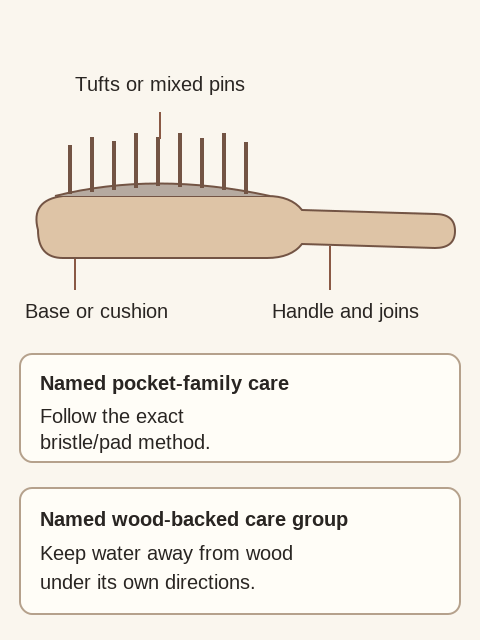
Remove loose hair in small areas
Set the brush on a clear work surface and start where the trapped hair is easy to see. Use fingers or a suitable maker-recommended cleaning tool to lift small amounts between the tufts. Keep the movement close to the visible strands instead of driving a pointed object into the base.
If a bundle resists, separate it into smaller accessible areas. Do not use the cushion as a lever point or pull the whole mat through the bristles at once. Put removed hair in the bin and inspect the base again before deciding whether visible residue needs a permitted wash.
Keep two manufacturer scopes separate
| Source example | What its published care describes | Boundary to retain |
|---|---|---|
| Mason Pearson pocket family | Removing hair, washing bristles/pad with warm water and mild shampoo, and bristles-down drying | Apply the exact family's current instructions; this is not universal immersion permission |
| Kent's listed bristle/wood-backed care group | Cleaning bristle tips while keeping water away from the wood, avoiding submersion and drying naturally | Use the relevant care group, not another brush category on the same page |
Read Mason Pearson's pocket care or Kent's product aftercare for the applicable method. Do not combine selected steps from both into a new universal recipe. Kent's shaving-brush or makeup-brush instructions are different sections for different tools.
Carry out only the wet care that is permitted
Have the named cleaner, a clean working area and the planned drying position ready before beginning. Keep the manufacturer-defined wet area separate from parts that must stay dry. A detachable pad on another brand does not establish that this cushion can be removed.
If the instructions are unavailable, finish loose-hair removal and ask the maker about the unresolved materials before attempting wet care. Do not replace missing permission with a long soak, harsh solvent or a disinfecting recipe. This is routine cleaning, not a sterilisation procedure.
Dry, inspect and then store
Use the documented orientation and allow the relevant parts to dry before putting the brush away. A dry-looking handle does not prove that a cushion or dense tuft base is dry. Do not accelerate the process with a radiator, hair dryer or direct sun unless the exact care directions explicitly allow that route.
After drying, inspect the cushion, joins and tufts. Residue and a damaged part are different findings. A rough contact point, loose component or changed cushion should lead to the condition-based replacement check, not progressively stronger cleaning.
Keep the brush and its care record together
Save the model name and current care instructions somewhere you can find again. A replacement brush with similar bristles can still have different base materials. For other manual designs, use general hairbrush cleaning; powered brushes have their own electrical-care guide.
For selection rather than maintenance, return to the boar-bristle guide. Keep a brush that remains suitable and maintainable rather than regarding ordinary loose hair as a reason for replacement.