Quick answer
Consider a compatible comb attachment when the documented stretching method fits your intended finish and you can guide its teeth through a prepared section. Consider a concentrator when you want to control airflow direction independently of a separate brush. Neither format establishes a faster, gentler or straighter result for every reader.
Compare the jobs without turning them into a ranking
The UK Dyson Supersonic wide-tooth-comb support page identifies a toothed attachment intended to help shape and lengthen hair as it dries. Dyson's US Supersonic styling article separately describes the concentrator's precision-styling role and the use of brushes. These establish different contact arrangements, not a shared operating recipe or a UK box-content list.
Table: swipe sideways on a small screen, or focus and use arrow keys.
| Question | Attached comb | Concentrator with a separate brush |
|---|---|---|
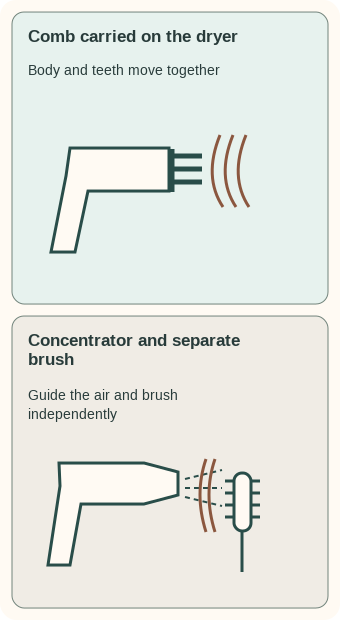
| What contacts the section? | Teeth carried on the dryer attachment | The independently held brush |
| What moves together? | The dryer body and comb | The nozzle follows the chosen brush path |
| What needs checking? | Tooth access, section preparation and body route | Brush control, nozzle direction and space for both hands |
| What does the format not prove? | Detangling permission for unprepared hair | That focused air alone supplies the intended tension or curve |
Start with the shape you want to preserve or change
Describe the job in ordinary terms: stretch a prepared section, guide a smoother length or shape an end around a chosen brush. Those are different tasks even when photographs show broadly similar finished hair. Do not regard stretching as proof of a permanent texture change or a measured straightening result.
If you want a diffuser-led routine that preserves a different intended shape, return to diffuser versus concentrator. If the job is only a final surface finish on an already suitable style, flyaway-attachment use owns that later stage. An extra attachment is useful only when it serves a defined task.
Chosen the comb? Follow the fit, section and release steps in how to use a hair dryer comb attachment.
Check contact and access before adding airflow
For a comb, inspect how the teeth and body would approach the section in the intended grip. Check the exact manual for the required preparation before operation. Do not pull an attached comb through a catch because the accessory includes the word comb. Stop the attempt and resolve the cause of resistance without dragging the dryer through it.
For a concentrator, inspect the space for the dryer and the separately guided brush. Consider the shortest section you intend to reach and the full path along the longest section. A brush that fits one area may still be awkward at another, and a nozzle's narrow opening does not establish enough working space.
These are access questions, not a heated trial. Where possible, understand the grip and route with a cool, disconnected tool before actual styling, then follow the exact operating directions. Concentrator-nozzle use owns the full brush-led method.
Resolve compatibility before the purchase
Record the body model, attachment identifier and maker-confirmed fit. Then check whether the selected box contains it. A shared manufacturer name or a picture of several accessories does not establish either fact. A support page showing one comb does not certify fit across every Supersonic generation or with another manufacturer's dryer.
Retain an ordinary hand comb as a separate item in that record. It can have a preparation role without being an electrical attachment. Likewise, a heated straightening brush is a different tool; its hair-state and operating instructions cannot be imported into a dryer-comb method.
Choose against the routine you already have
If your current brush-and-nozzle path is controlled and produces the intended shape, use that as the baseline. Identify the exact handling problem an attached comb would address before replacing it. If the attached comb already performs the required job, a concentrator needs a separate reason such as a brush-led curve you actually want to make.
Keep missing information visible instead of converting it into a product score. A published attachment description can establish a documented method; it cannot establish drying time, comfort or a preferred finish for your own section. Use blow-drying guidance to place the selected method within the wider routine.